👀 Visibility: The Hidden Force That Breaks or Builds Your Code
Welcome to Pillar 2 of the Concurrency & Multithreading: The Ultimate Engineer’s Bible series.
👀 Visibility: The Hidden Force That Breaks or Builds Your Code
Welcome to Pillar #2 of theConcurrency & Multithreading: The Ultimate Engineer’s Bibleseries.
🔗← Previous: Mutual Exclusion• 🔗→ Next: Atomicity*
🔝*Parent Blog: The Ultimate Guide to Concurrency & Multithreading
“What you can’t see will kill your code.”
— Every multithreaded bug you’ve ever chased at 3 AM.
✅ Read for free:Visibility: The Hidden Force That Breaks or Builds Your Code*
If it helped you, clap once. If it helped a lot, clap more. That’s how it reaches others too.*
In the last post, we talked aboutmutual exclusion— locking the door so only one thread can enter the room. But what if one thread updates a whiteboard and walks out, and the next thread walks in and still sees the old writing?
That, right there, is avisibility problem.
📦 What Is Visibility in Multithreading?
Visibility ensures that when one threadwritesto a shared variable, other threads canseethe latest value — not a cached, stale, or reordered version of it.
In single-threaded programs, you take this for granted. In multithreaded systems, youmust fight for it.
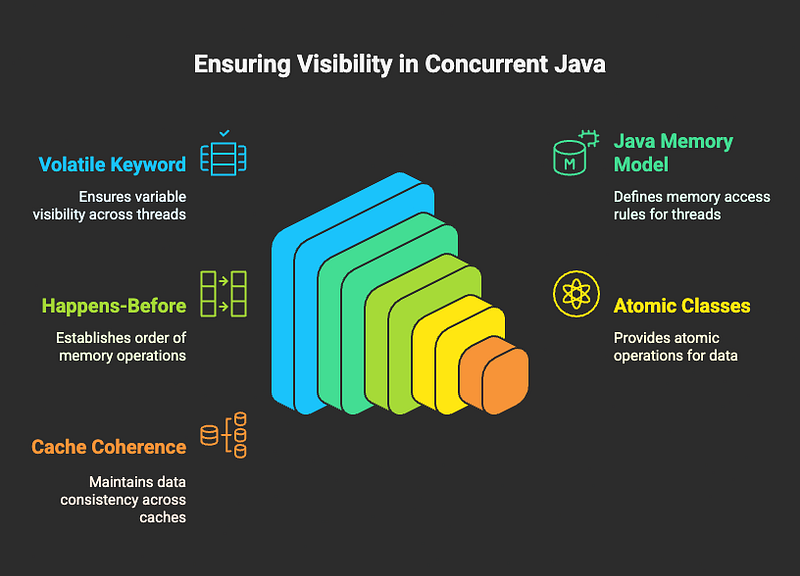
🧬 The Java Memory Model (JMM): The Battlefield
Java is not just juggling threads — it’s juggling CPU cores, caches, and compiler optimizations.
TheJava Memory Model (JMM)defines:
- Wherevariables live (thread-local caches, CPU registers, main memory)
- Whenupdates by one thread become visible to others
- Howinstructions can be reordered for performance
Without control, Thread A may write x = 42, and Thread B may never see that value — even seconds later.
🔑 The volatile Keyword — Your Visibility Switch
The volatile keyword tells the JVM and CPU:
“This variable must always be read from and written to main memory.”
Example
private volatile boolean running = true;public void stop() { running = false;}public void run() { while (running) { // do something }}
Without volatile, the running flag might becachedby the thread and never updated — causing an infinite loop.
🔄 Happens-Before: The Law of Ordering
Thehappens-beforerelationship is what makes volatile useful.
If Thread A writes to a volatile variable, and Thread B later reads it,
➡️ all actions in Abeforethe write become visible to Bafterthe read.
It’s not just visibility — it’sordering guarantees.
⚛️ Atomic Classes = Visibility + Atomicity
Java’s java.util.concurrent.atomic.* package gives you:
- AtomicInteger
- AtomicLong
- AtomicBoolean
- AtomicReference
These classes arelock-free, thread-safe, and visibility-guaranteed.
Example
AtomicInteger count = new AtomicInteger(0);count.incrementAndGet(); // atomic + visible
Perfect for counters, flags, and references in concurrent environments.
🚫 Cache Coherence: Why This Is So Damn Important
Modern CPUs haveL1/L2/L3 caches, and each thread may run on a different core.
One thread might update a variable, and another sees anold cached value— unless visibility is enforced.
volatile tells the CPU:
Flush it to main memory, and read it from there every time.
🔀 Instruction Reordering: The Invisible Enemy
The compiler or CPU mayreorder instructionsfor optimization, as long assingle-threaded behavior remains unchanged.
But in a multithreaded system, that’s deadly.
Example
ready = true; // Adata = 42; // B
May be reordered to:
data = 42; // Bready = true; // A
Unless you use volatile, synchronized, or atomic ops.
🧘 Analogy: Fogged Glass Office
Imagine two offices separated by a one-way fogged glass. Thread A writes to a shared note on the desk. Thread B looks at it through the fog andsees an older versionunless you wipe the glass every time.
That “wipe” is yourvisibility mechanism.
- volatile = Wipe the glass before and after every read/write.
- AtomicInteger = Comes with built-in glass cleaner.
- JMM = The manual that tells you how glass, pens, light, and time interact.
⚠️ When Not to Use
volatile
- Compound actions(count++, list.add()) arenot atomic.
- For full mutual exclusion, use synchronized or Lock.
- volatile is not a substitute for locking — it only guarantees visibility, not atomicity.
🧠 Summary Cheat Sheet
🚧 Common Bugs from Visibility Failures
- Flags not updating
- Threads stuck in infinite loops
- Data inconsistency despite “no errors”
- Debug logs show impossible states
🔍 Real-World Example
Broken Flag Check
boolean shutdown = false;void run() { while (!shutdown) { // process requests }}
Fixed
volatile boolean shutdown = false;
That one word avoids the nightmare of debugging invisible ghosts.
🛤️ What’s Next?
You’ve now understoodwhy threads see different realities— and how to fix that.
🔜Pillar #3: Atomicity— where we fight race conditions using CAS, atomic classes, and low-level primitives.
🧭 Series Navigation
- 🔝Parent Blog: The Ultimate Concurrency & Multithreading Guide
- ⬅️Previous: Mutual Exclusion
- ➡️Next: Atomicity
🛠️ Show Your Support
If this post brought you clarity, saved you hours of Googling, or challenged the way you think:
- 👏Clapto support the effort (you can hit it up to 50 times on Medium).
- 🔁Shareit with a fellow engineer or curious mind.
- 💬Commentwith questions, feedback, or requests — I read every one.
- 📩Requesta topic you’d like covered next.
- ⭐Followto stay ahead as new deep-dive posts drop.