🧱 Immutability — Thread Safety Without the Locks
Welcome to Pillar 7 of the Concurrency & Multithreading: The Ultimate Engineer’s Bible series.
🧱 Immutability — Thread Safety Without the Locks
Welcome to Pillar #7 of theConcurrency & Multithreading: The Ultimate Engineer’s Bibleseries.
🔗← Previous: Non-Blocking & Async• 🔗→ Next: Parallelism*
🔝*Parent Blog: The Ultimate Concurrency & Multithreading Guide
✅ Read for free:Immutability — Thread Safety Without the Locks*
If it helped you, clap once. If it helped a lot, clap more. That’s how it reaches others too.*
🧠 Imagine This:
What if you never had to worry about synchronized or volatile or locks?
What if your data could be safely shared across threadswithout any coordination?
That’s whatimmutabilitygives you.
No race conditions. No inconsistent state. No surprise bugs.
Let’s go deeper.
🧘♂️ Analogy: The Whiteboard vs. Stone Tablet
- Mutable object = whiteboard: anyone can erase or overwrite. Chaos in a multi-threaded room.
- Immutable object = engraved stone: once written, it never changes. Multiple readers, zero conflict.
🧬 Why Immutability Works in Concurrency
If data never changes, it never needs protection.
Java memory model guarantees that properly constructed immutable objects are safely shared across threadswithout synchronization.
Immutability is the“don’t fight”approach to thread safety.
🔐 How to Design an Immutable Class in Java
- Mark the class as final
- All fields should be private and final
- No setters
- Initialize fields via constructor
- If fields are objects, make defensive copies
✅ Example: Immutable
UserProfile
public final class UserProfile { private final String name; private final int age; public UserProfile(String name, int age) { this.name = name; this.age = age; } public String getName() { return name; } public int getAge() { return age; }}
Once created, this object can be safely shared between threadswithout locks.
🧠 Deep Insight: Defensive Copying
What if your field is a mutable object like a List or Date?
You must make adefensive copy.
public final class Schedule { private final List<String> tasks; public Schedule(List<String> tasks) { this.tasks = new ArrayList<>(tasks); // copy on creation } public List<String> getTasks() { return new ArrayList<>(tasks); // copy on read }}
Never return the actual internal state.
🧰 Java Features That Support Immutability
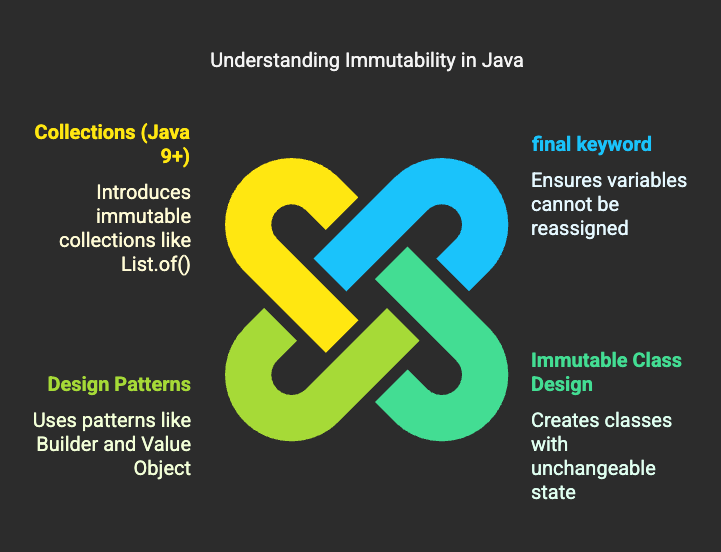
🔹 final keyword
Prevents reassignment. Used for:
- Local variables
- Method arguments
- Class fields
🔹 Value Objects
Objects that represent values (e.g., coordinates, dates, money) — perfect candidates for immutability.
🔹 Builder Pattern
Used for creating immutable objects with many fields.
User user = User.builder() .name("Nikhil") .email("nikhil@example.com") .build();
Lombok and modern IDEs make builders easy.
📦 Java Collections (Java 9+)
You can now easily create immutable collections:
List<String> names = List.of("Alice", "Bob");Map<String, Integer> score = Map.of("Math", 90, "CS", 95);
These are unmodifiable — attempts to change them will throw exceptions.
🧠 Pro Tip: Prefer Immutability Wherever You Can
- Share objects freely
- No locking overhead
- Safe to cache
- Easy to reason about
- Functional programming friendly
🔥 Real World Use Case
You’re designing a UserContext object passed across multiple microservices, threads, loggers, and security filters.
If it’s immutable, it becomes acontract.
Everyone trusts it. No surprises. No side effects.
💡 TL;DR
- Immutable objects = no synchronization required
- Design using final fields, no setters, constructors
- Use defensive copies for mutable types
- Prefer List.of(), Map.of() for collections
- Simpler, safer, and easier to test
In the next blog, we’ll dive intoParallelism— the art of breaking work into pieces and running them at the same time.
🧭 Series Navigation
- 🔝Parent Blog: The Ultimate Concurrency & Multithreading Guide
- ⬅️Previous: Non-Blocking & Async
- ➡️Next: Parallelism
🛠️ Show Your Support
If this post brought you clarity, saved you hours of Googling, or challenged the way you think:
- 👏Clapto support the effort (you can hit it up to 50 times on Medium).
- 🔁Shareit with a fellow engineer or curious mind.
- 💬Commentwith questions, feedback, or requests — I read every one.
- 📩Requesta topic you’d like covered next.
- ⭐Followto stay ahead as new deep-dive posts drop.