🧠 Programming Paradigms: Mastering the Mindsets of Code (with Java)
Programming paradigms aren’t just buzzwords — they’re the fundamental mindsets that shape how we think, design, and write software. They influence everything...
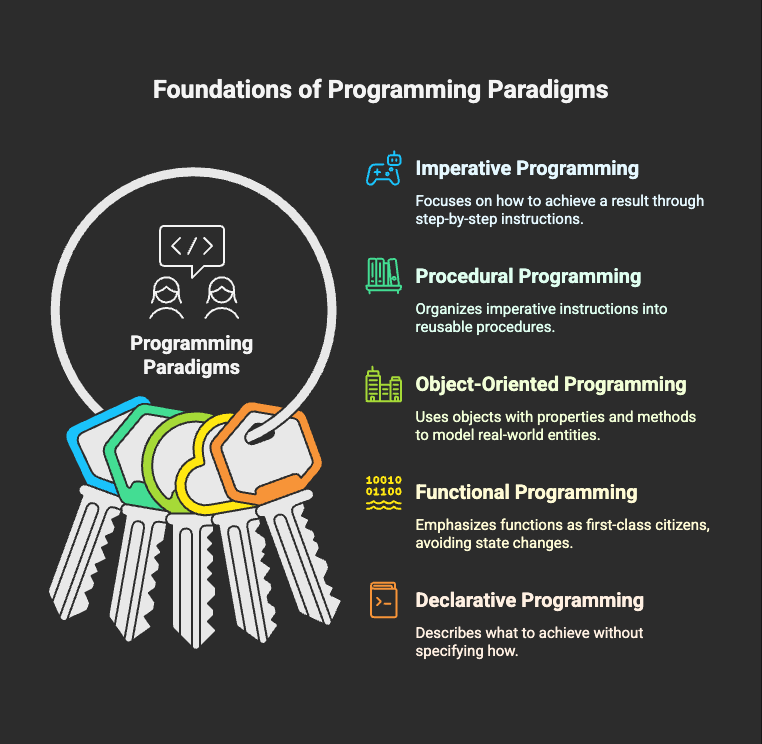
Programming paradigms aren’t just buzzwords — they’re the fundamental mindsets that shape how we think, design, and write software. They influence everything from variable scoping to how we approach scalability.
But here’s the problem: Most engineers have a vague idea of these paradigms, often confusing one for another, or assuming they’re mutually exclusive. Some even think paradigms are tied to languages. Let’s fix that. In this blog, you’ll deeply understand each paradigm, how they overlap, and where Java fits in. We’ll tackle this with code, comparisons, and clarity. Buckle up.
🚀 What Are Programming Paradigms?
Programming paradigms arephilosophies of programming— different approaches to thinking about and structuring software. They don’t just impact syntax, but dictate how you:
- Solve problems
- Design systems
- Manage data
- Handle complexity
Think of them as mental models. The better you understand them, the better your software design.
🔥 The Core Paradigms
We’ll cover five foundational paradigms:
- Imperative
- Procedural
- Object-Oriented Programming (OOP)
- Functional
- Declarative
We’ll use this problem as a baseline:
List<Integer> numbers = List.of(1, 2, 3, 4, 5, 6);// Goal: Return a list of even numbers
1. 🧱 Imperative Programming (Do this, then that)
“Tell the computer exactly how to do it.”
List<Integer> evens = new ArrayList<>();for (int number : numbers) { if (number % 2 == 0) { evens.add(number); }}System.out.println(evens);
- Focuses onhowto do things
- Relies on control flow: loops, conditionals, variables
- Most low-level languages (C, Assembly) are imperative by nature
✅ Imperative is the root of all other paradigms. All computers execute imperatively.
2. 🧩 Procedural Programming (Imperative + Organization)
“Break the task into functions.”
public class EvenFilter { public static boolean isEven(int n) { return n % 2 == 0; } public static List<Integer> filterEven(List<Integer> numbers) { List<Integer> result = new ArrayList<>(); for (int number : numbers) { if (isEven(number)) { result.add(number); } } return result; }}
- Subset of imperative
- Code is organized into reusable functions
- Easier to test and maintain
- Used heavily in C
✅ Procedural = Imperative + Modularity
3. 🧱➡️🏠 Object-Oriented Programming (OOP)
“Model the world with objects.”
class NumberFilter { private List<Integer> numbers; public NumberFilter(List<Integer> numbers) { this.numbers = numbers; } public List<Integer> getEvenNumbers() { return numbers.stream() .filter(n -> n % 2 == 0) .collect(Collectors.toList()); }}NumberFilter nf = new NumberFilter(numbers);System.out.println(nf.getEvenNumbers());
- Encapsulates data and behavior
- Promotes abstraction, inheritance, polymorphism
- Dominates enterprise systems (Java, C++)
✅ OOP can be imperative or declarative inside its methods. It’s a design philosophy, not just syntax.
4. 🧠 Functional Programming
“Write pure functions with no side effects.”
List<Integer> evens = numbers.stream() .filter(n -> n % 2 == 0) .collect(Collectors.toList());
- Emphasizes immutability
- Avoids shared state and side effects
- Pure functions: same input => same output
- Java 8+ enables FP via Streams, lambdas
✅ Functional and OOP can co-exist. Java is multi-paradigm.
5. 🧾 Declarative Programming
“Tell the computerwhatyou want, nothow.”
List<Integer> evens = numbers.stream() .filter(n -> n % 2 == 0) .toList();
- You declarewhatthe outcome should be
- Control flow is abstracted
- SQL is declarative:
SELECT number FROM numbers WHERE number % 2 = 0;
✅ Declarative overlaps with Functional (Streams) and OOP (Annotations in Spring).
⚖️ Common Confusions Explained
Is Procedural different from Imperative?
No. Procedural is a structuredsubsetof imperative. Every procedural program is imperative, but not every imperative program is procedural.
Is OOP a superset?
Yes. It uses imperative or declarative logic within classes. OOP organizes code differently — aroundentities and relationships.
Can Java do Functional Programming?
Yes — since Java 8. Streams, lambdas, method references are all functional features. But Java isnot a pure FP language(like Haskell).
Can paradigms be mixed?
Absolutely. In fact, real-world code ismulti-paradigm. A Java method might be imperative, inside an OOP class, using functional-style Streams.
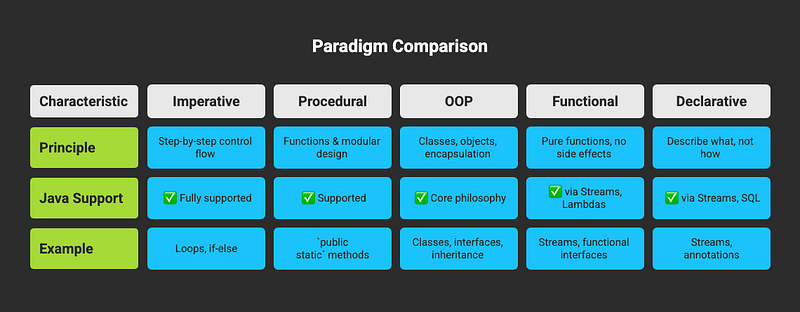
🧪 Summary Table
🧠 Final Thoughts
Programming paradigms are not isolated silos — they’re overlapping lenses through which you design software. Mastering them helps you:
- Pick the right abstraction
- Improve code quality
- Communicate better with peers
Java allows you to write code in multiple paradigms. Understand each, mix wisely, and you’ll be writing scalable, elegant, maintainable systems.
🙌 Enjoyed This?
If this helped you untangle the world of programming paradigms:
- 🖐 Clap to support this content
- 💬 Comment if anything was unclear — or if you want real-world examples in Spring/Kafka
- 🔁 Share with friends who are stuck in the “OOP = Java” mindset
- 👥 Follow me for upcoming breakdowns
Let’s make great engineering simple to understand.
Happy coding! ✨