The Software Engineer’s Pattern Playbook: When to Use What, Where, and Why
A comprehensive guide to design patterns, architectural patterns, and system design fundamentals
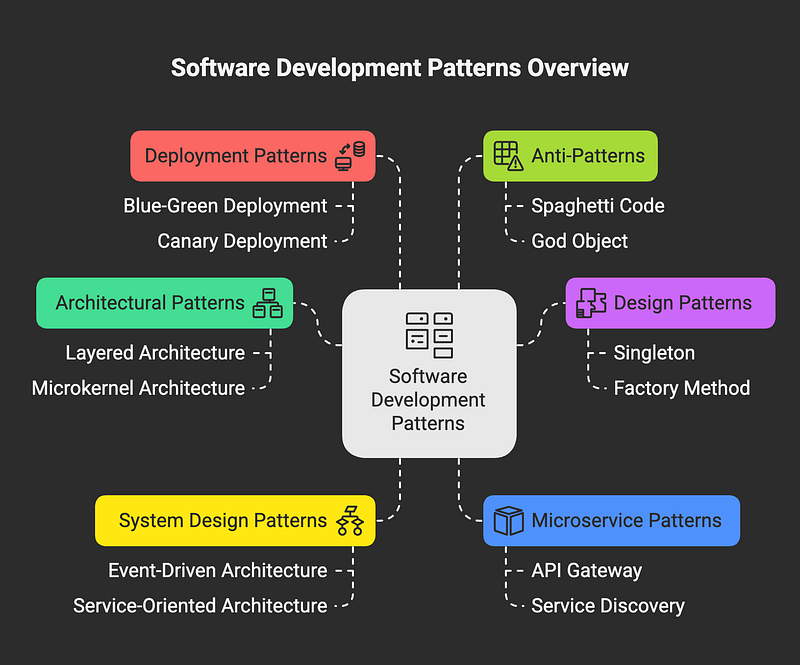
The Software Engineer’s Pattern Playbook: When to Use What, Where, and Why
A comprehensive guide to design patterns, architectural patterns, and system design fundamentals
🤔 The Confusion is Real
As software engineers, we’re constantly bombarded with terms like “system design,” “design patterns,” “architectural patterns,” “microservice patterns,” and “anti-patterns.” These concepts often overlap, leading to confusion about what belongs where and when to use what.
This guide aims to clear that confusion by organizing these concepts into a logical hierarchy that makes sense.
🎯 Understanding the Terminology Layers
1. System Design vs Design Patterns vs Architecture
Think of it like building construction:
- System Design= Urban planning (how the entire city works)
- Software Architecture= Building blueprints (structure of individual buildings)
- Design Patterns= Construction techniques (how to build doors, windows, foundations)
2. The Scope Hierarchy
MACRO LEVEL (City Planning)
├── System Design
│   └── How multiple services/systems work together
└── High-Level Design
    └── Major components and their interactions
MID LEVEL (Building Design)
├── Software Architecture
│   └── Overall structure of your application
└── Architectural Patterns
    └── Common ways to structure applications
MICRO LEVEL (Construction Techniques)
├── Design Patterns
│   └── Reusable solutions to common coding problems
└── Code Organization
    └── Classes, interfaces, methods
📚 Pattern Categories Explained
🏛️ Architectural Patterns
“How do I structure my entire application?”
Purpose:Define the overall structure and organization of software systems
Examples:
- Layered Architecture→ Organize code in horizontal layers (UI → Business → Data)
- Microservices→ Break application into small, independent services
- Event-Driven→ Components communicate through events
- Hexagonal (Ports & Adapters)→ Keep business logic isolated from external concerns
When to use:When designing the high-level structure of your application
🎨 Design Patterns (GoF)
“How do I solve this specific coding problem elegantly?”
Purpose:Provide reusable solutions to common programming problems at the code level
Categories:
- Creational→ Object creation (Factory, Singleton, Builder)
- Structural→ Object composition (Adapter, Decorator, Proxy)
- Behavioral→ Object interaction (Strategy, Observer, Command)
When to use:When writing code and facing common programming challenges
🔧 System Design Patterns
“How do I make my system scalable, reliable, and performant?”
Purpose:Address scalability, reliability, and performance in distributed systems
Examples:
- Load Balancer→ Distribute traffic across multiple servers
- Circuit Breaker→ Prevent cascade failures
- Cache-Aside→ Improve performance with caching
- Database Sharding→ Scale databases horizontally
When to use:When dealing with system scalability and reliability challenges
🧩 Microservice Patterns
“How do I design and operate microservices effectively?”
Purpose:Solve specific challenges that arise in microservice architectures
Examples:
- API Gateway→ Single entry point for all client requests
- Service Discovery→ Services find and communicate with each other
- Database per Service→ Each service owns its data
- Saga Pattern→ Handle distributed transactions
When to use:When building and operating microservice-based systems
🔗 Integration Patterns
“How do different parts of my system talk to each other?”
Purpose:Define how different components, services, or systems communicate
Examples:
- Message Queue→ Asynchronous communication via messages
- Request-Response→ Synchronous communication
- Publish-Subscribe→ One-to-many communication pattern
- Event Sourcing→ Store all changes as events
When to use:When designing communication between system components
🚀 Deployment Patterns
“How do I deploy and update my applications safely?”
Purpose:Define strategies for deploying and updating applications
Examples:
- Blue-Green Deployment→ Switch between two identical environments
- Canary Deployment→ Gradual rollout to a subset of users
- Rolling Update→ Update instances one by one
- Feature Flags→ Control feature availability without deployment
When to use:When planning deployment and release strategies
🔍 Observability Patterns
“How do I monitor and debug my distributed systems?”
Purpose:Make systems observable and debuggable
Examples:
- Distributed Tracing→ Track requests across multiple services
- Metrics Collection→ Gather system and business metrics
- Structured Logging→ Consistent, searchable log format
- Health Checks→ Monitor service availability
When to use:When implementing monitoring and debugging capabilities
🚨 Anti-Patterns
“What should I avoid doing?”
Purpose:Identify common mistakes and bad practices to avoid
Examples:
- God Object→ One class that does everything
- Spaghetti Code→ Tangled, unstructured code
- Copy-Paste Programming→ Duplicating code instead of abstracting
- Premature Optimization→ Optimizing before understanding bottlenecks
When to recognize:During code reviews and refactoring sessions
🎪 The Complete Software Development Map
SOFTWARE DEVELOPMENT
├── 1. FOUNDATIONS: Programming Core
│   ├── Language Mastery
│   │   ├── Java / Python / C++ / JavaScript — pick one and go deep
│   │   ├── Memory, Pointers, Garbage Collection
│   │   └── Compilation, JIT, Interpreters
│   ├── DSA: Data Structures & Algorithms
│   │   ├── Arrays, Trees, Graphs, Hashing
│   │   ├── Recursion, Dynamic Programming, Greedy, Backtracking
│   │   └── LeetCode-level mastery
│   ├── Problem-Solving Thinking
│   │   ├── Divide & Conquer
│   │   ├── Pattern Recognition
│   │   └── Time-Space Trade-offs
│   └── Code Quality
│       ├── Naming, Comments, Readability
│       └── Unit Testing, Refactoring, CI Hooks
│
├── 2. CODE DESIGN: Micro-Level Thinking
│   ├── Object-Oriented Programming
│   │   ├── Encapsulation, Abstraction, Inheritance, Polymorphism
│   │   ├── Real-world Modeling
│   │   └── Interface Segregation, Dependency Inversion
│   ├── SOLID + DRY + KISS + YAGNI
│   │   └── Timeless design principles
│   ├── Design Patterns (GoF)
│   │   ├── Creational → Singleton, Factory, Builder
│   │   ├── Structural → Adapter, Proxy, Decorator
│   │   └── Behavioral → Strategy, Observer, Command
│   └── Low-Level Design (LLD)
│       ├── Class Design, UML, Interfaces
│       └── Sequencing, Composition, Contracts
│
├── 3. SYSTEM ARCHITECTURE: Mid-Level Thinking
│   ├── Architecture Patterns
│   │   ├── Monolith, Modular Monolith, Microservices, Serverless
│   │   ├── MVC, MVVM, MVP
│   │   └── Hexagonal, Onion, Clean Architecture
│   ├── Layered Systems
│   │   ├── Presentation, Business, Data Layers
│   │   └── Separation of Concerns
│   ├── API Design
│   │   ├── REST, GraphQL, gRPC
│   │   ├── Pagination, Filtering, Versioning
│   │   └── OAuth2, JWT, Session vs Token Authentication
│   └── Integration Patterns
│       ├── Synchronous vs Asynchronous Communication
│       ├── Event-Driven Systems (Kafka, RabbitMQ)
│       └── CQRS, Event Sourcing, Saga Pattern
│
├── 4. SYSTEM DESIGN: Macro-Level Thinking
│   ├── High-Level Design (HLD)
│   │   ├── Services, APIs, Databases
│   │   ├── Caches, Queues, Load Balancers
│   │   └── Horizontal vs Vertical Scaling
│   ├── Low-Level Design (LLD)
│   │   ├── Class Diagrams, Interfaces, Data Modeling
│   │   ├── Composition vs Inheritance
│   │   └── API Contracts and Protocols
│   ├── Scaling Strategies
│   │   ├── Sharding, Partitioning, Indexing
│   │   ├── CDN, Redis, Memcached
│   │   └── Load Balancing, Throttling, Rate Limiting
│   └── Reliability Patterns
│       ├── Retry, Circuit Breaker, Bulkhead
│       ├── Failover, Redundancy
│       └── Eventual vs Strong Consistency
│
├── 5. INFRASTRUCTURE ENGINEERING
│   ├── DevOps
│   │   ├── Docker, Kubernetes, Helm
│   │   ├── Infrastructure as Code (Terraform, Pulumi)
│   │   └── CI/CD (GitHub Actions, GitLab CI, Jenkins)
│   ├── Cloud Platforms
│   │   ├── AWS / GCP / Azure — master one
│   │   ├── Compute, Storage, IAM, Networking
│   │   └── VPCs, Subnets, NAT, Firewalls
│   └── Deployment Patterns
│       ├── Blue-Green, Canary, Rolling Deployments
│       ├── Feature Flags
│       └── Zero-Downtime Deployments
│
├── 6. DATA SYSTEMS
│   ├── Relational Databases
│   │   ├── MySQL, PostgreSQL
│   │   └── Joins, Indexes, Normalization, ACID
│   ├── NoSQL Databases
│   │   ├── MongoDB, Cassandra
│   │   └── Redis, Neo4j
│   ├── Caching
│   │   ├── Redis, Memcached
│   │   ├── TTL, LRU, LFU
│   │   └── Write-Through, Write-Behind
│   └── Big Data & Pipelines
│       ├── Kafka, Flink, Spark
│       ├── ETL / ELT Patterns
│       └── Data Lake vs Data Warehouse
│
├── 7. SECURITY ENGINEERING
│   ├── OWASP Top 10
│   │   └── XSS, CSRF, SQL Injection, Broken Authentication
│   ├── Encryption & Identity
│   │   ├── HTTPS, TLS, AES, RSA
│   │   ├── OAuth2, OpenID Connect
│   │   └── SSO, MFA, Token Management
│   ├── Secrets Management
│   │   └── Vault, AWS Secrets Manager
│   └── Secure Design
│       ├── Principle of Least Privilege
│       └── Defense in Depth
│
├── 8. OBSERVABILITY & OPERATIONS
│   ├── Logging
│   │   ├── Structured Logging, Log Rotation
│   │   └── ELK Stack, Loki, Fluentd
│   ├── Metrics
│   │   ├── Prometheus, Grafana
│   │   └── Application & Infrastructure Metrics
│   ├── Tracing
│   │   ├── OpenTelemetry, Jaeger, Zipkin
│   │   └── Distributed Request Tracing
│   └── Alerting & Dashboards
│       ├── SLOs, SLIs, SLAs
│       └── Incident Management & On-Call
│
├── 9. TESTING & QUALITY
│   ├── Unit Testing
│   ├── Integration Testing
│   ├── End-to-End Testing
│   ├── TDD, BDD, Contract Testing
│   ├── Static Analysis (SonarQube, PMD)
│   └── Code Reviews, PR Process, Linting
│
└── 10. PRODUCT THINKING & SOFT SKILLS
│   ├── Product-Market Fit, MVP, Agile
│   ├── Design Docs, RFCs, Architecture Narratives
│   ├── Design Reviews & Cross-Team Communication
│   ├── Interview Preparation (DSA, LLD, HLD)
│   └── Mentorship, Ownership, Business Thinking
│
├── 11. LEADERSHIP & ENGINEERING STRATEGY
    ├── Technical Roadmaps
    ├── Engineering Economics
    ├── Platform Engineering
    ├── Organizational Design
    ├── Build vs Buy Decisions
    ├── Cost Optimization
    ├── Risk Management
    ├── Stakeholder Management
    └── Influencing Without Authority
Comprehensive list:https://raw.githubusercontent.com/nikhiltiwari005/sde-mental-map/refs/heads/main/epic_software_map.md
🧭 Quick Reference Guide
When Someone Says…
In Interviews, Expect…
- Junior/Mid-level:Design Patterns, SOLID principles, basic system design
- Senior:Architectural patterns, system design, integration patterns
- Principal/Staff:All patterns, trade-offs, when NOT to use patterns
🎯 Key Takeaways
- Patterns solve different problems at different scales— Use the right pattern for the right level
- Start small, grow complex— Don’t jump to microservices if a monolith works
- Patterns are tools, not rules— Know when to break them
- Context matters— The same pattern might be good or bad depending on your situation
- Master the fundamentals first— Solid programming skills beat fancy patterns every time
💡 Pro Tips
- Don’t pattern everything— Sometimes simple code is better than clever patterns
- Learn the problem before the solution— Understand why patterns exist
- Practice with real projects— Patterns make sense when you feel the pain they solve
- Read other people’s code— See how patterns are used in popular open-source projects
- Document your architecture decisions— Future you will thank present you
You don’t need to learn every single pattern. You just need to know they exist — so when the problem comes, your mind has the vocabulary to solve it.
🧠 The Ultimate Java Concurrency & Multithreading Roadmap (Deep, Transferable, Timeless)Master the 9 Pillars Every Engineer Must Knowmedium.comhttps://medium.com/javarevisited/the-concurrency-multithreading-bible-for-engineers-642d2c5c3a02🚀 DSA Mastery: The Ultimate Data Structures and Algorithms GuideA strategic roadmap to mastering data structures and algorithms, connecting theory to engineering and preparing you for…medium.comhttps://medium.com/javarevisited/dsa-mastery-the-ultimate-data-structures-and-algorithms-guide-120e6dddb9cd—
🛠️ Show Your Support
If this roadmap brought you clarity, saved you hours of planning, or gave you the confidence to start your DSA journey:
- 👏Clap to support the effort(you can hit it up to 50 times on Medium)
- 🔁Share itwith a fellow engineer or curious mind
- 💬Commentwith questions, feedback, or requests, I read every one
- 📩Request a topicyou’d like covered next in our series
- ⭐Followto stay ahead as new deep-dive posts drop
- 🔖Save this postyou’ll reference it throughout your journey
Remember: The best engineers don’t just know patterns — they know when NOT to use them.