🚀 DSA Mastery: The Ultimate Data Structures and Algorithms Guide
A strategic roadmap to mastering data structures and algorithms, connecting theory to engineering and preparing you for elite coding interviews.
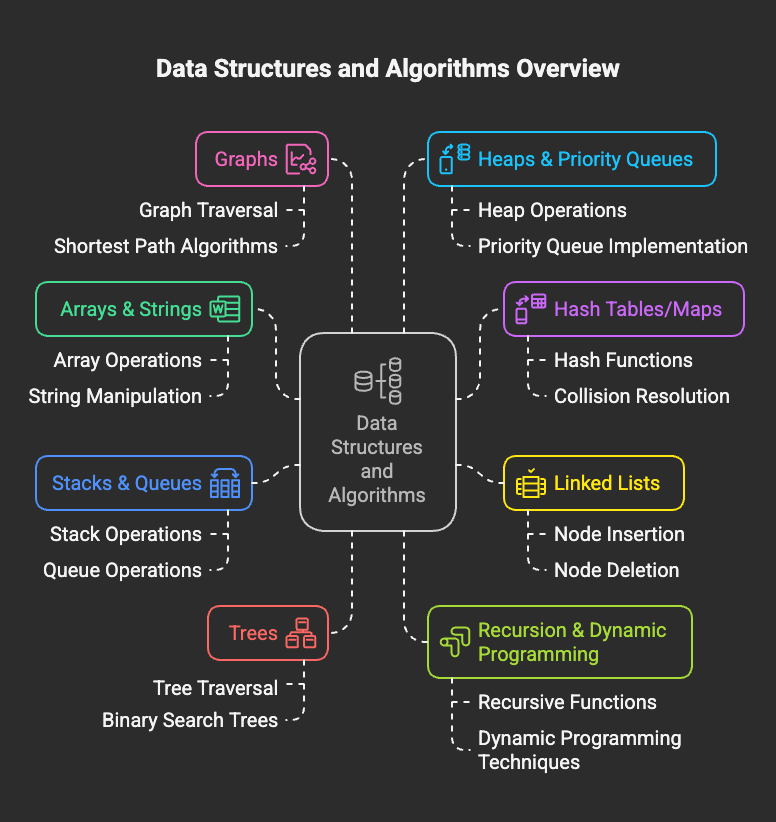
🚀 DSA Mastery: The Ultimate Data Structures and Algorithms Guide
A strategic roadmap to mastering data structures and algorithms, connecting theory to engineering and preparing you for elite coding interviews.
What is DSA and Why It Matters
Definitions
- Data Structures: Ways to organize and store data in memory
- Algorithms: Step-by-step procedures to process that data efficiently
Types of Data Structures
- Linear: Arrays, Linked Lists, Stacks, Queues (sequential access)
- Non-Linear: Trees, Graphs, Hash Tables (hierarchical/networked access)
- Specialized: Heaps, Tries, Sets (optimized for specific operations)
Types of Algorithms
- Searching: Find specific data (Binary Search, DFS, BFS)
- Sorting: Organize data (Quick Sort, Merge Sort)
- Optimization: Find best solutions (Dynamic Programming, Greedy)
- Graph Processing: Navigate relationships (Shortest Path, Network Flow)
Why Learn DSA
- Performance Impact: Right choice = 1ms vs 1000ms response time. Example: Hash table lookup O(1) vs array search O(n)
- Problem-Solving Skills: Break complex problems into solvable pieces
- Career Advantage: 90% of tech interviews test DSA knowledge
- System Design: Understanding when your system will scale vs break
Real-World Applications
- Social Media: Graph algorithms for friend recommendations
- GPS Navigation: Shortest path algorithms for route optimization
- Databases: B-tree indexing for fast queries
- Operating Systems: Heap structures for memory management
- Search Engines: Tries for autocomplete, ranking algorithms
🗺️ Comprehensive DSA Mental Map
🗂️ Data Structures
Data Structures
├── Linear Structures
│   ├── Array
│   ├── Linked List
│   │   ├── Singly
│   │   ├── Doubly
│   │   └── Circular
│   ├── Stack
│   └── Queue
│       ├── Simple
│       ├── Circular
│       ├── Deque
│       └── Priority Queue
│
├── Non-Linear Structures
│   ├── Trees
│   │   ├── Binary Tree
│   │   ├── Binary Search Tree (BST)
│   │   ├── AVL Tree
│   │   ├── Red-Black Tree
│   │   ├── Segment Tree
│   │   ├── Fenwick Tree (Binary Indexed Tree)
│   │   ├── N-ary Tree
│   │   └── Trie
│   └── Graphs
│       ├── Directed / Undirected
│       ├── Weighted / Unweighted
│       └── Cyclic / Acyclic
│
├── Hash-Based Structures
│   ├── HashMap
│   ├── HashSet
│   ├── Hashtable
│   └── Bloom Filter
│
├── Heap Structures
│   ├── Min Heap
│   ├── Max Heap
│   └── Fibonacci Heap
│
├── Disjoint Sets
│   └── Union-Find (Disjoint Set Union - DSU)
│
├── Matrix / Grid
│   ├── 2D Arrays
│   ├── Sparse Matrix
│   └── Prefix Sum Grid
│
└── Specialized / Hybrid
    ├── Suffix Tree / Array
    ├── Interval Tree
    ├── KD-Tree
    └── Compressed Trie (Radix Tree)
⚙️ Algorithms
Algorithms
├── Paradigms
│   ├── Brute Force
│   ├── Divide and Conquer
│   ├── Greedy
│   ├── Dynamic Programming
│   ├── Backtracking
│   ├── Recursion / Memoization
│   ├── Branch and Bound
│   ├── Sliding Window
│   ├── Two Pointers
│   └── Bit Manipulation
│
├── Sorting
│   ├── Bubble Sort
│   ├── Selection Sort
│   ├── Insertion Sort
│   ├── Merge Sort
│   ├── Quick Sort
│   └── Heap / Counting / Radix Sort
│
├── Searching
│   ├── Linear Search
│   ├── Binary Search
│   ├── Ternary Search
│   ├── Jump Search
│   └── Interpolation Search
│
├── Graph Algorithms
│   ├── BFS / DFS
│   ├── Dijkstra’s Algorithm
│   ├── Bellman-Ford Algorithm
│   ├── Kruskal’s Algorithm
│   ├── Prim’s Algorithm
│   ├── Topological Sort
│   ├── Union-Find (Cycle Detection)
│   ├── Tarjan’s Algorithm (SCC)
│   └── A* Search Algorithm
│
├── Tree Algorithms
│   ├── Tree Traversals
│   ├── Lowest Common Ancestor (Binary Lifting)
│   └── Segment Tree Queries
│
├── Greedy Algorithms
│   ├── Huffman Encoding
│   ├── Activity Selection
│   ├── Job Scheduling
│   └── Fractional Knapsack
│
├── Dynamic Programming Techniques
│   ├── 1D / 2D / Grid DP
│   ├── Bitmask DP
│   ├── DP on Trees
│   └── Digit / State Compression
│
├── String Algorithms
│   ├── Knuth-Morris-Pratt (KMP)
│   ├── Rabin-Karp
│   ├── Z-Algorithm
│   ├── Trie / Aho-Corasick
│   └── Manacher’s Algorithm
│
├── Math & Number Theory
│   ├── GCD / LCM
│   ├── Modulo Arithmetic
│   ├── Sieve of Eratosthenes
│   └── Matrix Exponentiation
│
├── Geometry Algorithms
│   ├── Convex Hull
│   ├── Line Sweep
│   └── Closest Pair
│
└── Miscellaneous
    ├── Randomized Algorithms
    ├── Monte Carlo / Las Vegas Algorithms
    ├── Genetic Algorithms
    └── Minimax Algorithm (Game Theory)
🥇 Tier 1: The Foundation (Master First — 70% Coverage)
1. Arrays & Strings
Arrays & Strings
├── Basic Operations
│   ├── Indexing & Traversal
│   ├── Insertion & Deletion
│   └── Resizing & Memory Management
│
├── Fundamental Patterns
│   ├── Two Pointers
│   │   ├── Opposite Direction (Palindrome, Two Sum)
│   │   ├── Same Direction (Remove Duplicates)
│   │   └── Fast-Slow (Cycle Detection)
│   ├── Sliding Window
│   │   ├── Fixed Size (Max Sum Subarray)
│   │   ├── Variable Size (Longest Substring)
│   │   └── Shrinking Window (Min Window Substring)
│   └── Prefix/Suffix Processing
│       ├── Prefix Sums (Range Queries)
│       ├── Product Arrays (Except Self)
│       └── Running Calculations
│
├── String-Specific Techniques
│   ├── Character Frequency Analysis
│   ├── Pattern Matching (KMP, Rabin-Karp)
│   ├── Anagram Detection
│   └── Palindrome Detection
│
└── Advanced Applications
    ├── Dutch National Flag (3-way partitioning)
    ├── Boyer-Moore Majority Vote
    └── Kadane's Algorithm (Maximum Subarray)
2. Hash Tables/Maps
Hash Tables
├── Core Concepts
│   ├── Hash Functions & Collision Handling
│   ├── Load Factor & Resizing
│   └── Time Complexity Analysis
│
├── Data Structure Variants
│   ├── HashMap (Key-Value pairs)
│   ├── HashSet (Unique elements)
│   ├── MultiMap (Multiple values per key)
│   └── LRU Cache Implementation
│
├── Common Patterns
│   ├── Frequency Counting
│   │   ├── Character/Element Frequency
│   │   ├── Top K Frequent Elements
│   │   └── First Non-Repeating Character
│   ├── Fast Lookups
│   │   ├── Two Sum Variations
│   │   ├── Complement Searching
│   │   └── Existence Checking
│   ├── Grouping & Classification
│   │   ├── Group Anagrams
│   │   ├── Phone Number to Words
│   │   └── Category Organization
│   └── Caching & Memoization
│       ├── Dynamic Programming Optimization
│       ├── Function Result Caching
│       └── Previously Computed Values
│
└── Advanced Applications
    ├── Sliding Window with HashMap
    ├── Subarray Sum Problems
    └── Longest Sequence Problems
🥈 Tier 2: Pattern Recognition (Next 20% Coverage)
3. Linked Lists
Linked Lists
├── Types & Structures
│   ├── Singly Linked List
│   ├── Doubly Linked List
│   ├── Circular Linked List
│   └── Skip Lists (Advanced)
│
├── Fundamental Operations
│   ├── Insertion (Head, Tail, Middle)
│   ├── Deletion (By Value, Position)
│   ├── Search & Traversal
│   └── Length Calculation
│
├── Core Patterns
│   ├── Two Pointer Techniques
│   │   ├── Fast-Slow (Floyd's Cycle Detection)
│   │   ├── Finding Middle Element
│   │   └── Detecting Intersections
│   ├── Reversal Techniques
│   │   ├── Iterative Reversal
│   │   ├── Recursive Reversal
│   │   └── Partial Reversal (M to N)
│   └── Merging & Splitting
│       ├── Merge Sorted Lists
│       ├── Split at Position
│       └── Partition Around Value
│
└── Advanced Problems
    ├── Add Two Numbers (as Lists)
    ├── Remove Nth from End
    ├── Rotate List
    └── Copy List with Random Pointer
4. Stacks & Queues
Stacks & Queues
├── Stack Applications
│   ├── Basic Operations (Push, Pop, Peek)
│   ├── Expression Evaluation
│   │   ├── Balanced Parentheses
│   │   ├── Infix to Postfix
│   │   └── Calculator Implementations
│   ├── Monotonic Stack
│   │   ├── Next Greater Element
│   │   ├── Largest Rectangle in Histogram
│   │   └── Trapping Rain Water
│   └── Backtracking Support
│       ├── Path Tracking
│       ├── State Management
│       └── Undo Operations
│
├── Queue Applications
│   ├── Basic Operations (Enqueue, Dequeue)
│   ├── Breadth-First Search
│   ├── Level-Order Processing
│   └── Sliding Window Maximum (Deque)
│
├── Specialized Variants
│   ├── Priority Queue (Heap-based)
│   ├── Circular Queue
│   ├── Double-Ended Queue (Deque)
│   └── Min/Max Stack
│
└── Real-World Applications
    ├── Browser History (Stack)
    ├── Print Queue Management
    ├── CPU Scheduling
    └── Undo/Redo Functionality
5. Trees
Trees
├── Tree Types
│   ├── Binary Tree
│   ├── Binary Search Tree (BST)
│   ├── AVL Tree (Self-Balancing)
│   ├── Red-Black Tree
│   ├── N-ary Tree
│   └── Trie (Prefix Tree)
│
├── Traversal Methods
│   ├── Depth-First Search (DFS)
│   │   ├── Preorder (Root → Left → Right)
│   │   ├── Inorder (Left → Root → Right)
│   │   └── Postorder (Left → Right → Root)
│   └── Breadth-First Search (BFS)
│       ├── Level-Order Traversal
│       ├── Level-by-Level Processing
│       └── Zigzag Traversal
│
├── Core Problems & Patterns
│   ├── Tree Construction
│   │   ├── From Preorder/Inorder
│   │   ├── From Postorder/Inorder
│   │   └── From Array Representation
│   ├── Tree Properties
│   │   ├── Height & Depth Calculations
│   │   ├── Diameter of Tree
│   │   ├── Balanced Tree Validation
│   │   └── Symmetric Tree Checking
│   ├── Path Problems
│   │   ├── Root to Leaf Paths
│   │   ├── Path Sum Calculations
│   │   ├── Maximum Path Sum
│   │   └── Lowest Common Ancestor (LCA)
│   └── Tree Modification
│       ├── Insertion & Deletion in BST
│       ├── Tree Flattening
│       ├── Mirror/Invert Operations
│       └── Subtree Operations
│
└── Advanced Applications
    ├── Serialize/Deserialize
    ├── Tree to Linked List Conversion
    ├── Range Sum Queries (Segment Tree)
    └── Autocomplete (Trie Applications)
🥉 Tier 3: Advanced Concepts (Final 10% Coverage)
6. Recursion & Dynamic Programming
Recursion & Dynamic Programming
├── Recursion Fundamentals
│   ├── Base Cases & Recursive Cases
│   ├── Call Stack Understanding
│   ├── Tail Recursion Optimization
│   └── Recursive Tree Visualization
│
├── Backtracking Patterns
│   ├── Decision Trees
│   │   ├── Generate Parentheses
│   │   ├── Letter Combinations
│   │   └── IP Address Restoration
│   ├── Constraint Satisfaction
│   │   ├── N-Queens Problem
│   │   ├── Sudoku Solver
│   │   └── Graph Coloring
│   ├── Combinatorial Problems
│   │   ├── Subsets & Power Set
│   │   ├── Permutations & Combinations
│   │   └── Partition Problems
│   └── Path Finding
│       ├── Maze Solving
│       ├── Word Search in Grid
│       └── Path with Obstacles
│
├── Dynamic Programming Types
│   ├── 1D DP
│   │   ├── Fibonacci Sequence
│   │   ├── Climbing Stairs
│   │   ├── House Robber
│   │   └── Decode Ways
│   ├── 2D DP
│   │   ├── Grid Path Problems
│   │   ├── Longest Common Subsequence
│   │   ├── Edit Distance
│   │   └── Matrix Chain Multiplication
│   ├── String DP
│   │   ├── Longest Palindromic Subsequence
│   │   ├── Regular Expression Matching
│   │   ├── Wildcard Pattern Matching
│   │   └── Distinct Subsequences
│   └── Advanced DP
│       ├── Knapsack Variations (0/1, Unbounded)
│       ├── Coin Change Problems
│       ├── Longest Increasing Subsequence
│       └── Stock Trading Problems
│
├── Optimization Techniques
│   ├── Memoization (Top-Down)
│   ├── Tabulation (Bottom-Up)
│   ├── Space Optimization
│   └── State Compression
│
└── Pattern Recognition
    ├── Optimal Substructure Identification
    ├── Overlapping Subproblems Detection
    ├── State Definition Strategies
    └── Transition Equation Formulation
7. Graphs
Graphs
├── Graph Representations
│   ├── Adjacency Matrix
│   ├── Adjacency List
│   ├── Edge List
│   └── Implicit Graphs (Grid Problems)
│
├── Graph Types
│   ├── Directed vs Undirected
│   ├── Weighted vs Unweighted
│   ├── Cyclic vs Acyclic (DAG)
│   └── Connected vs Disconnected
│
├── Traversal Algorithms
│   ├── Depth-First Search (DFS)
│   │   ├── Recursive Implementation
│   │   ├── Iterative with Stack
│   │   ├── Path Finding
│   │   └── Cycle Detection
│   └── Breadth-First Search (BFS)
│       ├── Queue-Based Implementation
│       ├── Shortest Path (Unweighted)
│       ├── Level-by-Level Exploration
│       └── Connected Components
│
├── Advanced Algorithms
│   ├── Shortest Path Algorithms
│   │   ├── Dijkstra's Algorithm (Weighted, Positive)
│   │   ├── Bellman-Ford (Negative Weights)
│   │   ├── Floyd-Warshall (All Pairs)
│   │   └── A* Search (Heuristic-Based)
│   ├── Minimum Spanning Tree
│   │   ├── Kruskal's Algorithm
│   │   ├── Prim's Algorithm
│   │   └── Union-Find Data Structure
│   ├── Topological Sorting
│   │   ├── DFS-Based Approach
│   │   ├── Kahn's Algorithm (BFS)
│   │   └── Course Scheduling Problems
│   └── Strongly Connected Components
│       ├── Kosaraju's Algorithm
│       ├── Tarjan's Algorithm
│       └── Applications in System Design
│
├── Special Graph Problems
│   ├── Bipartite Graph Detection
│   ├── Graph Coloring
│   ├── Hamilton Path/Cycle
│   ├── Traveling Salesman Problem
│   └── Network Flow Problems
│
└── Real-World Applications
    ├── Social Network Analysis
    ├── Web Page Ranking (PageRank)
    ├── GPS Navigation Systems
    └── Dependency Resolution
8. Heaps & Priority Queues
Heaps & Priority Queues
├── Heap Types
│   ├── Min Heap (Smallest at Root)
│   ├── Max Heap (Largest at Root)
│   ├── Binary Heap (Complete Binary Tree)
│   ├── Binomial Heap
│   └── Fibonacci Heap
│
├── Core Operations
│   ├── Insert (Heapify Up)
│   ├── Extract Min/Max (Heapify Down)
│   ├── Peek (Get Min/Max)
│   ├── Delete Arbitrary Element
│   └── Build Heap from Array
│
├── Common Patterns
│   ├── Top K Problems
│   │   ├── K Largest/Smallest Elements
│   │   ├── K Closest Points
│   │   ├── K Frequent Elements
│   │   └── Kth Largest Element
│   ├── Streaming Data
│   │   ├── Running Median
│   │   ├── Sliding Window Maximum
│   │   └── Data Stream Statistics
│   ├── Merge Operations
│   │   ├── Merge K Sorted Lists
│   │   ├── Merge K Sorted Arrays
│   │   └── K-Way Merge
│   └── Scheduling Problems
│       ├── Meeting Room Scheduling
│       ├── Task Scheduling with Priority
│       └── CPU Scheduling Algorithms
│
├── Advanced Applications
│   ├── Dijkstra's Algorithm (Shortest Path)
│   ├── Huffman Coding (Compression)
│   ├── A* Search Algorithm
│   └── Minimum Spanning Tree (Prim's)
│
└── Implementation Details
    ├── Array-Based Representation
    ├── Index Calculations (Parent/Child)
    ├── Heapify Algorithms
    └── Space and Time Complexity
🔗 How Everything Connects
The DSA universe is interconnected:
- Arrays→Hash Tables(for optimization)
- Arrays→Two Pointers(for space efficiency)
- Recursion→Dynamic Programming(for optimization)
- Trees→Graphs(trees are special graphs)
- Stacks→Recursion(call stack simulation)
- Queues→BFS(level-by-level processing)
- Heaps→Priority Queues(efficient priority management)
Understanding these connections helps you see when to apply which technique and how to combine approaches for complex problems.
📚 Best Resources
💻 Learning Platforms
- LeetCode— Best for interview prep
- GeeksforGeeks— Great explanations with examples
- AlgoExpert— Structured video course (paid)
📖 Books
- Cracking the Coding Interview— Interview-focused
- Elements of Programming Interviews— Problem-solving approach
🎥 Video Resources
- Abdul Bari(YouTube)— Mathematical approach
- Back To Back SWE— Interview-focused explanations
📰 Blogs
- Our DSA Mastery Series— Detailed topic breakdowns (coming soon)
🧭 DSA Mastery Series Navigation
📍You Are Here: Complete Roadmap & Mental Map
🔜Coming Next:
- Post 2: Arrays & Strings Mastery (with 20+ solved examples)
- Post 3: Hash Tables & Maps Deep-Dive (real-world implementations)
- Post 4: Two Pointers & Sliding Window Techniques
- Post 5: Tree Algorithms & Traversals
- Post 6: Recursion & Backtracking Fundamentals
- Post 7: Dynamic Programming Mastery
- Post 8: Graph Algorithms & Applications
- Post 9: Heaps & Priority Queue Systems
- Post 10: Advanced DSA Topics
- Post 11: System Design with DSA
- Post 12: Interview Strategy & Mock Sessions
💡Pro Tip: Bookmark this roadmap, you’ll reference it throughout your DSA journey!
🔗 Related Deep-Dive Series
If you’re looking forConcurrency & Multithreadingtechnical guide, check out our completed series:
🧠 The Ultimate Java Concurrency & Multithreading Roadmap (Deep, Transferable, Timeless)Master the 9 Pillars Every Engineer Must Knowmedium.comhttps://medium.com/javarevisited/the-concurrency-multithreading-bible-for-engineers-642d2c5c3a02Same systematic approach, complete coverage, and practical focus, but for mastering concurrent programming in Java.
🛠️ Show Your Support
If this roadmap brought you clarity, saved you hours of planning, or gave you the confidence to start your DSA journey:
- 👏Clap to support the effort(you can hit it up to 50 times on Medium)
- 🔁Share itwith a fellow engineer or curious mind
- 💬Commentwith questions, feedback, or requests, I read every one
- 📩Request a topicyou’d like covered next in our series
- ⭐Followto stay ahead as new deep-dive posts drop
- 🔖Save this postyou’ll reference it throughout your journey
💡 Remember to save this comprehensive roadmap for easy reference as you progress through your DSA mastery journey!