From Zero to Hero in AI: The Complete Mental Map (2026 Edition)
A comprehensive roadmap for software engineers and beginners who want to understand the entire AI ecosystem. Learn how Artificial Intelligence, Machine Learning, Deep Learning, LLMs, Embeddings, RAG, AI Agents, and Production AI systems connect together through a single mental model.
From Zero to Hero in AI: The Complete Mental Map (2026 Edition)
Most beginners make the same mistake.
They start learning random tools:
- ChatGPT
- LangChain
- Vector Databases
- Hugging Face
- RAG
- Agents
Six months later, they know dozens of buzzwords but cannot explain how an AI system actually works.
The solution is to build a mental map first.
Think of AI as a city. Before exploring individual buildings, understand the city’s layout.
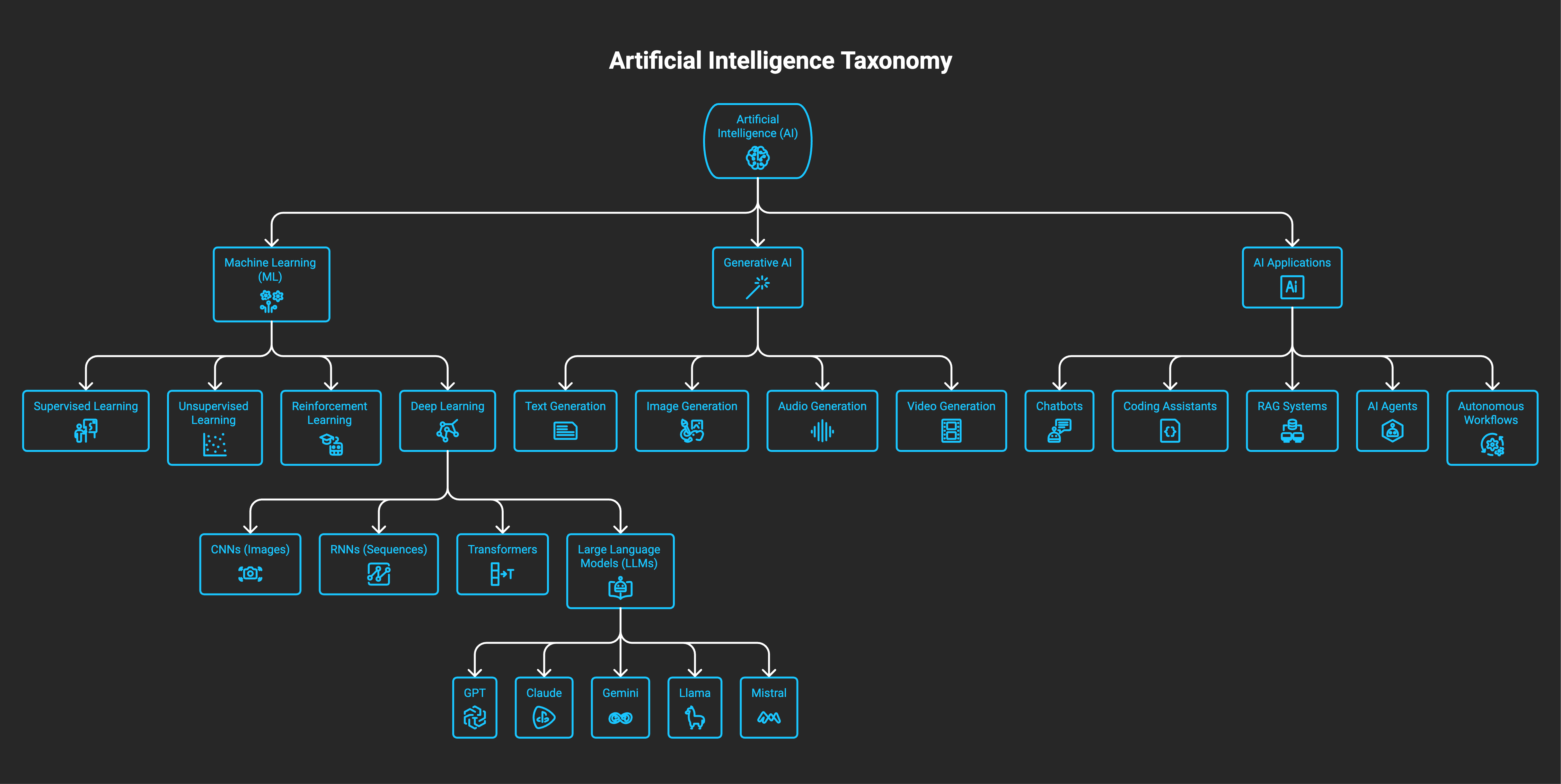
The Big Picture
Artificial Intelligence (AI)
│
├── Machine Learning (ML)
│   │
│   ├── Supervised Learning
│   ├── Unsupervised Learning
│   ├── Reinforcement Learning
│   └── Deep Learning
│        │
│        ├── CNNs (Images)
│        ├── RNNs (Sequences)
│        ├── Transformers
│        │
│        └── Large Language Models (LLMs)
│              │
│              ├── GPT
│              ├── Claude
│              ├── Gemini
│              ├── Llama
│              └── Mistral
│
├── Generative AI
│    │
│    ├── Text Generation
│    ├── Image Generation
│    ├── Audio Generation
│    └── Video Generation
│
└── AI Applications
      │
      ├── Chatbots
      ├── Coding Assistants
      ├── RAG Systems
      ├── AI Agents
      └── Autonomous Workflows
Stage 1: Learn Traditional Programming
Before AI, become comfortable with software engineering fundamentals.
Focus on:
- Variables
- Functions
- OOP
- APIs
- Databases
- Git
- Linux
- Data Structures
- Algorithms
Recommended language:
Python
Python is the dominant language in AI and Machine Learning.
Stage 2: Learn Machine Learning
Machine Learning teaches computers to find patterns from data.
Traditional Software:
Input + Rules → Output
Machine Learning:
Input + Output → Model Learns Rules
Mental Map:
Machine Learning
│
├── Regression
│    └── Predict Numbers
│
├── Classification
│    └── Predict Categories
│
├── Clustering
│    └── Group Similar Data
│
└── Recommendation Systems
Learn:
- Linear Regression
- Logistic Regression
- Decision Trees
- Random Forests
- XGBoost
Tools:
- NumPy
- Pandas
- Matplotlib
- Scikit-Learn
Stage 3: Learn Deep Learning
Machine Learning struggles with images, audio, and language.
Deep Learning solves this.
Mental Map:
Deep Learning
│
├── Neural Networks
│
├── Computer Vision
│    ├── CNN
│    └── Object Detection
│
├── NLP
│    ├── Embeddings
│    ├── Attention
│    └── Transformers
│
└── Generative Models
Learn:
- Neural Networks
- Backpropagation
- Gradient Descent
- Attention Mechanism
- Transformers
Frameworks:
- PyTorch
- TensorFlow
Today, PyTorch dominates research and modern AI development.
Stage 4: Understand LLMs
Everything changes here.
Modern AI is powered by Large Language Models.
Mental Model:
Massive Text Data
        │
        ▼
 Transformer Training
        │
        ▼
      LLM
        │
        ├── Chat
        ├── Summarization
        ├── Coding
        ├── Translation
        └── Reasoning
Important Concepts:
Tokens
Context Window
Embeddings
Attention
Fine-Tuning
Inference
Prompt Engineering
Understand these deeply before learning frameworks.
Stage 5: Learn Embeddings
This is where many beginners get lost.
An embedding converts text into numbers.
Example:
"Dog" → [0.82, 0.13, 0.74 ...]
"Cat" → [0.80, 0.11, 0.76 ...]
Because Dog and Cat are similar, their vectors are close together.
Embeddings enable:
- Semantic Search
- RAG
- Recommendations
- Knowledge Retrieval
Mental Map:
Text
 │
 ▼
Embedding Model
 │
 ▼
Vector
 │
 ▼
Vector Database
Stage 6: Learn RAG
RAG stands for Retrieval-Augmented Generation.
Without RAG:
User
  │
  ▼
LLM
  │
  ▼
Answer
With RAG:
User
  │
  ▼
Retriever
  │
  ▼
Knowledge Base
  │
  ▼
LLM
  │
  ▼
Answer
Why?
LLMs cannot know your private documents.
RAG gives them access.
Used in:
- Internal company chatbots
- Documentation assistants
- Customer support systems
- Enterprise AI products
Core Components:
Documents
   │
Chunking
   │
Embeddings
   │
Vector DB
   │
Retriever
   │
LLM
Stage 7: Learn AI Agents
A chatbot answers questions.
An agent performs actions.
Mental Map:
AI Agent
│
├── LLM Brain
├── Memory
├── Tools
├── Planning
└── Execution
Example:
User:
Book me a vacation.
Agent:
1. Search Flights
2. Compare Prices
3. Search Hotels
4. Create Itinerary
5. Send Report
The agent can think, plan, and act.
Stage 8: Multi-Agent Systems
One agent eventually becomes many agents.
Mental Map:
Manager Agent
│
├── Research Agent
├── Coding Agent
├── Testing Agent
├── Documentation Agent
└── Review Agent
This mirrors how real companies operate.
Stage 9: Production AI Engineering
This is where companies pay serious money.
Mental Map:
Production AI
│
├── Prompt Engineering
├── Evaluation
├── Observability
├── Guardrails
├── Cost Optimization
├── Caching
├── RAG
├── Agents
└── Deployment
Tools:
- LangChain
- LangGraph
- LlamaIndex
- OpenAI SDK
- vLLM
- Ollama
The Complete AI Roadmap
Programming
     │
     ▼
Python
     │
     ▼
Math Basics
     │
     ▼
Machine Learning
     │
     ▼
Deep Learning
     │
     ▼
Transformers
     │
     ▼
LLMs
     │
     ▼
Embeddings
     │
     ▼
Vector Databases
     │
     ▼
RAG
     │
     ▼
Agents
     │
     ▼
Multi-Agent Systems
     │
     ▼
Production AI Engineering
What Most Engineers Should Learn
If your goal is building AI products instead of becoming an AI researcher:
20% Theory
80% Building
Focus on:
- Python
- APIs
- LLMs
- Embeddings
- Vector Databases
- RAG
- Agents
- Evaluation
- Deployment
You do not need a PhD to build useful AI systems.
You need a strong mental model, consistent practice, and real projects.
Master the map first.
Then every new AI buzzword becomes just another building in a city you already understand.