DSA Series: Master This to Instantly Level Up Your Programming Career
The Foundation Behind Efficient Software and Cracking Big Tech Interviews
DSA Series: Master This to Instantly Level Up Your Programming Career
The Foundation Behind Efficient Software and Cracking Big Tech Interviews
📍 Executive Summary
Data Structures and Algorithms (DSA) form thecore foundation of computer science. Whether you’re designing scalable systems, optimizing queries, or preparing for interviews —DSA is your ultimate power tool. This blog explains the “why” behind DSA, provides intuitive analogies, and sets the stage for mastering it.
🚀 Why DSA Matters in Real Life
Let’s compare scenarios with and without DSA:
Searching a book:
- Without DSA:You’re scanning randomly through a messy room.
- With DSA:You use a categorized library index — it’s structured and efficient.
Managing files:
- Without DSA:Files are scattered.
- With DSA:You sort and group them in folders using a structure like a tree.
Handling user requests:
- Without DSA:Everyone yells at once.
- With DSA:Requests go into a queue and are served one at a time.
🧩 What Are Data Structures?
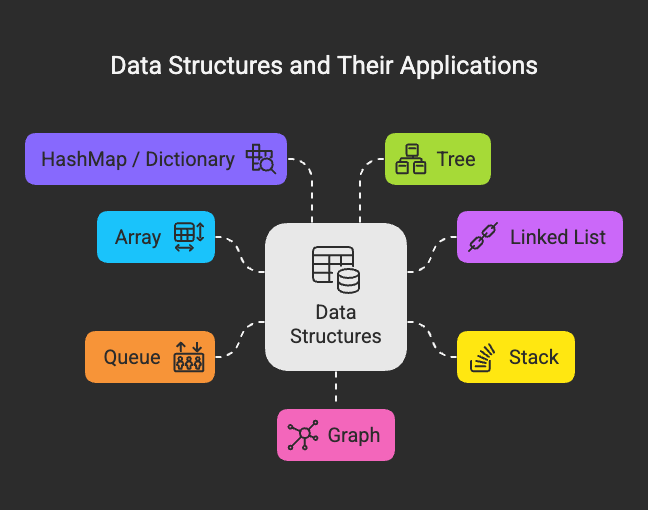
Data structures areways to organize and store data efficiently. Key examples:
- Array— A fixed-size collection of elements (like a leaderboard).
- Linked List— Items connected like a chain (e.g., playlist songs).
- Stack— Last-In-First-Out (browser back button).
- Queue— First-In-First-Out (printing jobs).
- HashMap / Dictionary— Fast lookup by key (e.g., username → profile).
- Tree— Hierarchical (file system, XML, JSON).
- Graph— Nodes connected in networks (social media, maps).
⚙️ What Are Algorithms?
Algorithms arestep-by-step proceduresto solve a problem. They can be:
- Searching(e.g., binary search)
- Sorting(e.g., quicksort, mergesort)
- Graph traversal(e.g., BFS, DFS)
- Pathfinding(e.g., Dijkstra’s algorithm)
Performance Metrics:
- Time Complexity: Measures speed.
- Space Complexity: Measures memory usage.
💼 Where DSA Is Used in Real Life
Examples from different domains:
- Social Media— Suggesting friends or content → Uses graphs & hashing.
- Navigation Apps— Finding shortest route → Uses graph algorithms.
- Compilers— Code parsing and optimization → Uses trees and stacks.
- Databases— Indexing and searching → Uses B-Trees and hash maps.
- Operating Systems— Scheduling and memory management → Queues, heaps.
- Games— Pathfinding, AI logic → Graphs, dynamic programming.
👨💻 Why DSA Matters in Interviews
Top tech companies use DSA toevaluate problem-solving skills. Here’s what you’ll encounter:
- Common problem types:Arrays, strings, trees, graphs.
- Focus:Optimization, reasoning, clean coding.
- Goal:Demonstrate how you think and solve, not just syntax.
🛠️ Choosing the Right Tool for the Job
Here are common problems and what to use:
- Need constant-time lookup → UseHashMap
- Fast insert/delete at ends → UseDequeorLinkedList
- Maintain recent history → UseStack
- Need frequent min/max → UsePriorityQueueorHeap
- Store hierarchical data → UseTree
- Represent connections → UseGraph
- Solve overlapping subproblems → UseDynamic Programming
🙋 FAQs
**Q: I already know how to code. Why care about DSA?
**A: DSA helps you scale, optimize, and build real-world systems efficiently.
**Q: Learn DSA before frameworks?
**A: Yes, it’s a core skill that applies across languages and tech stacks.
**Q: How do I know I’m good at DSA?
**A: You can pick the right tool for a problem, write optimal code, and explain your logic clearly.
📌 Call to Action
Next Up →Arrays Deep Dive
FollowDSA seriesto go from fundamentals to mastery. DSA will change how you write and think about code.