🧠 Understanding Primitive Types in Programming: The Building Blocks of Code
As a newcomer to programming, you’ll quickly encounter the term “primitive types.” These foundational elements are the atoms of programming languages — the s...
🧠 Understanding Primitive Types in Programming: The Building Blocks of Code
Introduction
As a newcomer to programming, you’ll quickly encounter the term “primitive types.” These foundational elements are the atoms of programming languages — the simplest data types from which all complex structures are built. Understanding primitive types is essential for anyone starting their coding journey, regardless of which language you ultimately pursue.
In this guide, we’ll explore what primitive types are, examine the most common ones across programming languages, and discuss why mastering them is crucial for your development as a programmer.
What Are Primitive Types?
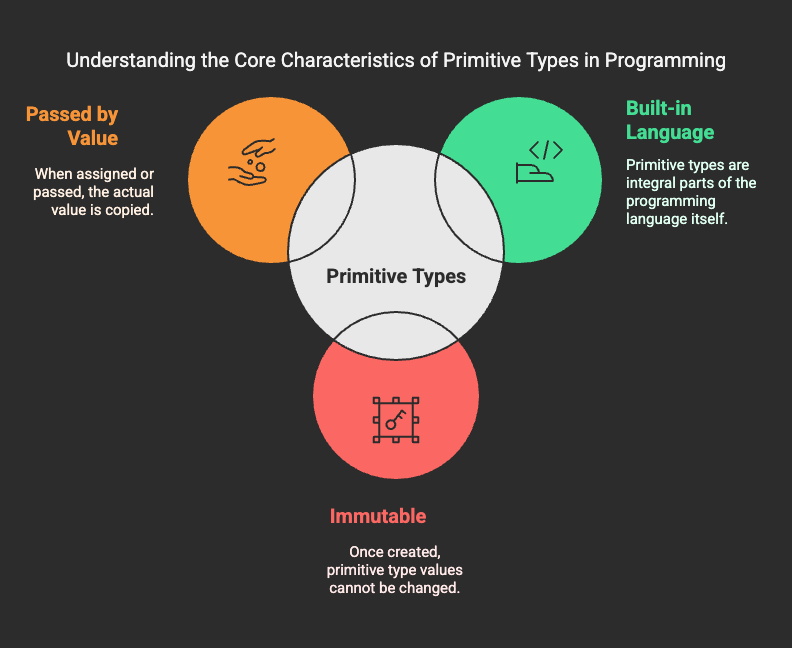
Primitive types (sometimes called “primitive data types” or simply “primitives”) are the basic building blocks provided by programming languages to represent simple values. They share three key characteristics:
- They’re built into the language: Primitive types are fundamental parts of the programming language itself.
- They’re immutable: Once created, their values cannot be changed (though variables holding them can be reassigned).
- They’re passed by value: When assigned to another variable or passed to a function, the actual value gets copied.
Unlike complex types (like objects or arrays), primitive types don’t have methods and represent only a single, simple value.
Common Primitive Types Across Languages
While each programming language implements primitive types slightly differently, most share these common categories:
Numbers
Numbers come in various forms, depending on the language and your specific needs:
Integers: Whole numbers without decimal points
- Examples:
-10,0,42,1000 - Common types:
int,long,short,byte
Floating-Point: Numbers with decimal points
- Examples:
3.14,-0.01,2.0 - Common types:
float,double
JavaScript primarily uses a single Number type to represent both integers and floating-point values, which simplifies numerical operations compared to languages like Java or C# that have multiple numeric types (like int, float, double) with varying sizes and ranges. However, JavaScript also provides BigInt for safely working with very large integers, and offers typed arrays like Uint8Array and Float32Array for handling raw binary data and performing high-performance numerical tasks — commonly used in graphics, audio, and low-level operations.
Booleans
Booleans represent logical values with just two possible states:
truefalse
Though simple, booleans form the foundation of all logical operations and control flow in programming.
Characters
Characters represent single textual symbols:
- Examples:
'a','5','$',' '(space) - Usually represented as
charin typed languages
In languages like C and Java, characters are distinct from strings. Many modern languages treat single characters as tiny strings.
Strings
Some languages (like JavaScript) treat strings as primitive types, while others consider them complex types built from character arrays:
- Examples:
"Hello","123","" - Typically surrounded by quotes
Special Values
Many languages include special primitive values:
- Null/Nil: Represents the intentional absence of any value
- Undefined: In JavaScript, represents variables that have been declared but not assigned a value
- Unit/Void: In some languages, represents the absence of useful information (often as a function return)
Why Primitive Types Matter
Understanding primitive types goes beyond academic interest — it impacts how you write code in significant ways:
Memory Efficiency
Primitive types use a fixed, typically small amount of memory. When working with large datasets or performance-critical applications, choosing the right primitive type can dramatically impact memory usage and processing speed.
Predictable Behavior
Operations on primitive types behave consistently across all instances. For example, comparing two integers will always follow the same rules, making your code more predictable.
Foundation for Complex Structures
All complex data structures — from arrays to sophisticated objects — are ultimately built upon primitive types. Mastering primitives provides insight into how more complex structures function under the hood.
Language-Specific Examples
Let’s see how primitive types appear in some popular programming languages:
JavaScript
let number = 42; // Number (floating point)let decimal = 3.14; // Also a Number (JS uses IEEE 754 double-precision floats)let bigInt = 9007199254740991n; // BigInt for arbitrarily large integerslet text = "Hello"; // Stringlet isActive = true; // Booleanlet unique = Symbol("id"); // Symbol, a unique and immutable primitivelet empty = null; // Null (intentional absence of value)let notDefined; // Undefined (declared but not assigned)
Java
int count = 50; // Integer (32-bit)double price = 19.99; // Double precision floating-pointchar grade = 'A'; // Single characterboolean isComplete = true; // BooleanString name = "Java"; // String (technically not primitive in Java)
Python
count = 50 # intprice = 19.99 # floatis_complete = True # boolname = "Python" # strnothing = None # NoneType
Common Pitfalls to Avoid
Even with primitive types, there are several common mistakes beginners should watch out for:
Type Coercion Confusion
In dynamically-typed languages like JavaScript, values can be automatically converted between types:
"5" + 2 // Results in "52" (string concatenation)"5" - 2 // Results in 3 (numeric subtraction)
This implicit type conversion can lead to unexpected results if you’re not careful.
Floating-Point Precision
Due to how computers represent decimal numbers in binary, floating-point calculations can sometimes yield surprising results:
0.1 + 0.2 // Results in 0.30000000000000004, not exactly 0.3
For financial calculations or precise decimal work, specialized libraries or decimal types are often necessary.
Reference vs. Value Comparisons
Understanding that primitives are compared by their values (not their references) is crucial:
let a = 5;let b = 5;console.log(a === b); // true, because the values are the same
This behavior differs from complex types like objects, which are compared by reference.
Conclusion
Primitive types may seem simple at first glance, but they form the essential foundation upon which all programming is built. By understanding how these basic building blocks work, you’ll be better equipped to understand more complex programming concepts and debug issues that arise in your code.
Whether you’re building a simple calculator or a complex web application, primitive types will be there every step of the way, forming the bedrock of your program’s data. Master them early, and you’ll have a much smoother journey ahead as a developer.
Did you find this explanation helpful? What other fundamental programming concepts would you like to see explained? Let me know in the comments below!