🧠 Coding Styles 101: Declarative vs Imperative vs Functional vs Procedural Explained Simply…
A beginner friendly guide to the 4 core programming paradigms with real world examples, analogies, and clear code snippets.
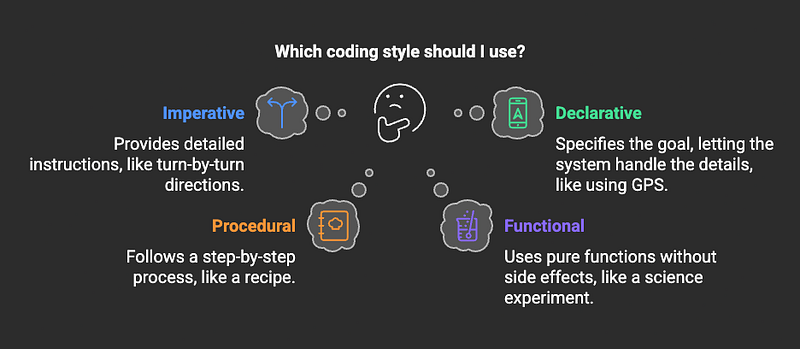
🧠 Coding Styles 101: Declarative vs Imperative vs Functional vs Procedural Explained Simply (Python)
A beginner-friendly guide to the 4 core programming paradigms with real-world examples, analogies, and clear code snippets.
🚀 Introduction
When you’re new to programming, you’ll often come across terms likeimperative,declarative,functional, andprocedural. And it might sound like a complex theory class. But don’t worry — these are juststyles of writing code.
Imagine you’re giving instructions to someone. You could say:
- “Go to the kitchen, open the fridge, grab the bottle of water, pour it into a glass.”
- Or you could just say, “Get me a glass of water.”
That’s the difference betweenimperative(step-by-step instructions) anddeclarative(just stating the outcome).
In this guide, we’ll break it all down using:
✅ Real-life analogies
✅ Beginner-friendly examples (in Python and JavaScript)
✅ Pros & cons
✅ Clear distinctions
1. 🧩 What Are Programming Paradigms?
Aprogramming paradigmis a way of thinking about and structuring code. Think of it as a mindset or philosophy you adopt when solving problems through programming.
Different paradigms give you different ways to express logic and behavior.
Let’s explore the four most talked-about paradigms.
2. 🔧 Imperative Programming
Imperative programmingis like giving someonestep-by-step instructionsto achieve a task.
🗣️“First do this, then that, then this…”
It focuses onhowto do things.
✅ Example (Python)
numbers = [1, 2, 3, 4]squares = []for n in numbers: squares.append(n * n)print(squares) # [1, 4, 9, 16]
You manually manage the loop and update the squares list.
🧠 Analogy
Telling a robot:
“Walk to the kitchen → open the fridge → grab a bottle → pour water into a glass.”
✅ Pros:
- Good for beginners
- Full control over the flow
- Clear understanding of what’s happening
❌ Cons:
- Verbose
- Can lead to messy code as logic grows
- Harder to debug when codebase scales
3. 🧘 Declarative Programming
Declarative programmingis aboutwhatyou want, nothowto get it.
🗣️“Just give me the final result.”
Let the system figure out the steps.
✅ Example (Python — List Comprehension)
numbers = [1, 2, 3, 4]squares = [n * n for n in numbers]print(squares)
You’re not tellinghowto iterate — you’re stating what you want.
✅ Example (SQL)
SELECT name FROM employees WHERE salary > 50000;
You’re not saying how to fetch data — just what you want.
🧠 Analogy
Saying: “Get me a glass of water.” The robot decides how to do it.
✅ Pros:
- Concise and readable
- Less error-prone
- Easier to maintain
❌ Cons:
- Less control over the process
- Can be harder to debug if unfamiliar
4. 🧠 Functional Programming
Functional programming (FP)is a subset of declarative programming that treats functions asfirst-class citizensand avoids mutable state.
It focuses onpure functions,immutability, andno side effects.
✅ Example (JavaScript)
const numbers = [1, 2, 3, 4];const squares = numbers.map(n => n * n);console.log(squares);
You’re using apure function(map) that returns a new array.
🧠 Analogy
Math-style thinking: f(x) = x². Given the same input, always return the same output.
🧬 Key Concepts:
- Pure functions(no side effects)
- Immutability
- Higher-order functions(functions that return or accept other functions)
- No shared state
✅ Pros:
- Easier to test
- Great for concurrency and parallelism
- Predictable
❌ Cons:
- Steeper learning curve
- Can be verbose without proper syntax sugar
5. 🧱 Procedural Programming
Procedural programmingis actually a type ofimperative programmingthat organizes code intoprocedures(functions).
It breaks tasks intoreusable procedures.
✅ Example (Python)
def square_all(numbers): result = [] for n in numbers: result.append(n * n) return result
print(square_all([1, 2, 3]))
🧠 Analogy
Like writing a cookbook: each recipe (procedure) defines steps to make a dish.
✅ Pros:
- Easy to structure small projects
- Clear control flow
- Great for early-stage learning
❌ Cons:
- Harder to manage large codebases
- Global state can become messy
🆚 Side-by-Side Comparison
🤔 Which Paradigm Should You Learn First?
✅Start with Imperative & Procedural— they’re beginner-friendly and most tutorials start here.
Then explore:
🚀Functional— once you’re comfortable with loops and logic, FP will level up your code quality.
🎯Declarative— as you use libraries and frameworks (like React, SQL), you’ll naturally encounter declarative patterns.
You don’t have to pick one. Modern programming blends all these paradigms depending on what’s best for the job!
🙋♂️ FAQs
Q: Which paradigm should I learn first as a beginner?
A: Most beginners start with imperative and procedural programming, especially with languages like C, Java, or Python. These paradigms help build a strong foundation in how code executes step-by-step.
**Q: Is functional programming the same as declarative programming?
**A: Not exactly. Functional programming is a type of declarative paradigm, but not all declarative code is functional. Functional programming emphasizes immutability and pure functions, while declarative programming is more about describing what you want, not how.
**Q: Can a programming language support multiple paradigms?
**A: Yes! Many modern languages are multi-paradigm. For example, JavaScript, Python, and even Java support imperative, declarative, and functional styles.
Q: Why is declarative programming considered easier to maintain?
A: Because you describe what you want rather than how to do it, making the code more concise, readable, and closer to human intent. This often leads to fewer bugs and easier refactoring.
Q: Is object-oriented programming (OOP) a paradigm too?
A: Yes, OOP is another important programming paradigm focused on objects, classes, and encapsulation. It is often combined with imperative or procedural styles.
Q: What’s the key difference between functional and procedural programming?
A: Procedural programming focuses on functions that operate on data and maintain state, often using loops and variables. 📦 Functional programming emphasizes pure functions (no side effects) and immutability (no changing state), often using recursion and higher-order functions.
Q: Is SQL declarative or imperative?
A: SQL is a declarative language. You write what data you want, and the engine figures out how to get it.
**Q: Can functional programming be used for real-world applications?
**A: Absolutely! Frameworks like React (JavaScript) use functional concepts. Languages like Scala, Haskell, F#, and Elixir are widely used in production systems.
🧠 Conclusion
Learning these paradigms is like learning different accents of the same language. You can express the same idea in multiple ways — and knowing which one fits best is a mark of a great developer.
If you’re just starting out, focus on writing clear, logical code. As you gain experience, explore other paradigms towrite smarter, cleaner, and more scalable software.
🚀 Continue Learning
👉 Dive deeper intoProgramming Concepts Seriesfor more beginner-friendly blogs on core ideas every developer should know.