⚡ Non-Blocking & Async: The Future Has No wait()
Welcome to Pillar 6 of the Concurrency & Multithreading: The Ultimate Engineer’s Bible series.
⚡ Non-Blocking & Async: The Future Has No wait()
Welcome to Pillar #6 of theConcurrency & Multithreading: The Ultimate Engineer’s Bibleseries.
🔗 ←Previous: Task Management• 🔗 →Next: Immutability*
🔝*Parent Blog: The Ultimate Guide to Concurrency & Multithreading
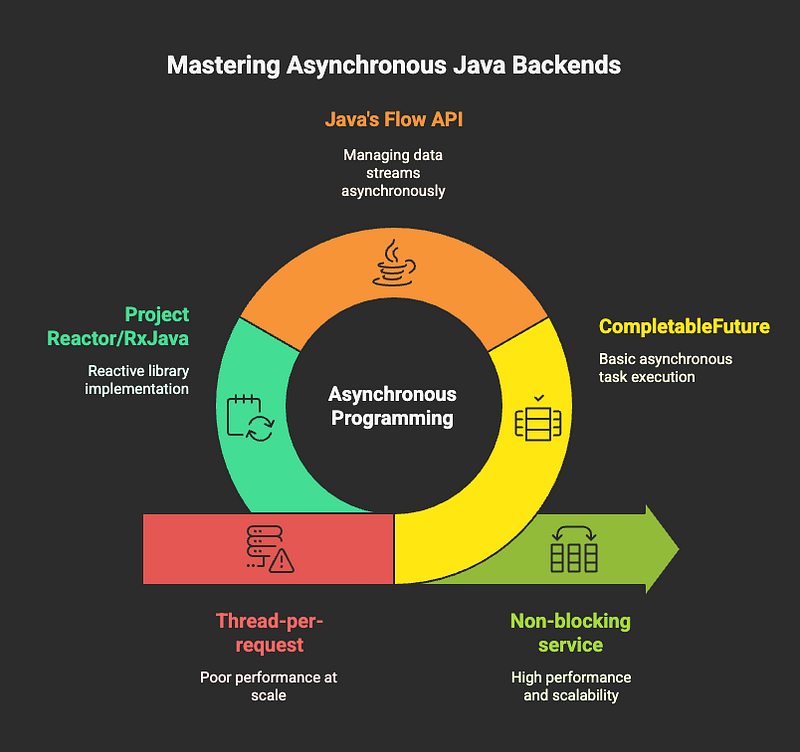
In the modern high-performance world of Java backend development, non-blocking and asynchronous programming is not optional — it’s table stakes. If your service is thread-per-request, you are dead on arrival at scale. So let’s deconstruct it from first principles to enterprise-grade architecture, starting from CompletableFuture, to Java’s Flow API, to battle-tested reactive libraries like Project Reactor and RxJava.
✅ Read for free:Non-Blocking & Async Non-Blocking & Async: The Future Has No wait()*
If it helped you, clap once. If it helped a lot, clap more. That’s how it reaches others too.*
🔁 Blocking vs Non-Blocking: The Core Mental Model
Imagine a restaurant.
- Blocking I/Ois like having one chef who takes one customer’s order and won’t take another until the first order is cooked and served.
- Non-blocking I/Ois like that chef taking the order, passing it to the kitchen, and moving to the next customer without waiting.
Blocking ties up threads while waiting. Non-blocking frees them up to do useful work.
⚙️ Asynchronous vs Synchronous
- Synchronous: You call a function and wait (block) until it returns.
- Asynchronous: You call a function, it returns immediately (usually with a future/promise), and your code gets notified later with the result.
Non-blocking ≠ asynchronous, but they often go hand-in-hand.
🔍 Are Non-Blocking and Async the Same?
No, they’re related but not identical.
In the concurrency world, these terms are often (incorrectly) used interchangeably. Let’s define them precisely:
Non-Blocking: A thread doesn’t wait (i.e., block) for an operation to complete. It continues executing.
Asynchronous: The caller initiates an operation and moves on. The result is handled later (callback, future, etc.).
💡All asynchronous operations are non-blocking, but not all non-blocking operations are asynchronous.
Example:
- A
CompletableFuture.supplyAsync()is both non-blocking and asynchronous. - A call to
ConcurrentLinkedQueue.poll()is non-blocking but synchronous (it happens immediately on the same thread without delay or delegation).
🎯 Real-World Analogy: The Restaurant Kitchen
Imagine a chef handling multiple customer orders.
- Blocking / Synchronous: The chef takes Order #1 and waits until the dish is fully cooked before starting Order #2.
- Non-Blocking / Async: The chef starts Order #1, throws it in the oven, and while it’s cooking, starts Order #2. When Order #1 is done, a bell rings, and the chef finishes plating it.
In the second case, the chef (CPU thread) is never idle while waiting for something to “cook” (I/O). That’s efficiency.
Learn more about Resource Limitation (CPU, Memory, I/O, and Thread Bottlenecks):https://nikhiltiwari005.medium.com/understanding-resource-limitations-in-modern-systems-a-practical-guide-21cc9ccb26a8
✅ CompletableFuture — The Gateway Drug to Async in Java
Java 8’s CompletableFuture is the easiest way to dip your toes into async and non-blocking computation.
🔨 Basics
CompletableFuture<String> future = CompletableFuture.supplyAsync(() -> { // runs in ForkJoinPool.commonPool() return fetchFromRemoteService();});
🔗 Composing Futures
future .thenApply(data -> transform(data)) // Transform result .thenAccept(finalData -> save(finalData)); // Use result
🤝 Combining Futures
CompletableFuture<String> future1 = fetchUser();CompletableFuture<String> future2 = fetchProfile();future1.thenCombine(future2, (user, profile) -> merge(user, profile));
🛡️ Error Handling
future .exceptionally(ex -> handleError(ex)) .whenComplete((result, ex) -> audit(result, ex));
⛓️ allOf(), anyOf() for Coordination
CompletableFuture<Void> all = CompletableFuture.allOf(future1, future2, future3);CompletableFuture<Object> any = CompletableFuture.anyOf(future1, future2);
✅ Ideal for:
- Simple async chains
- When you want control but not complexity
🚫 Not ideal for:
- Complex dataflow dependencies
- Stream-like data (backpressure, flow control)
🧩 Java 9 Flow API — The Missing Piece of Reactive Streams
Java 9 introduced the Flow API to standardize reactive programming interfaces in the JDK. It’s based on the Reactive Streams Specification.
🧠 Key Interfaces
- Publisher: Produces data
- Subscriber: Consumes data
- Processor: A combination of both
- Subscription: Represents a connection, allows requesting elements
public class MySubscriber<T> implements Flow.Subscriber<T> { private Flow.Subscription subscription; @Override public void onSubscribe(Flow.Subscription subscription) { this.subscription = subscription; subscription.request(1); // backpressure control } @Override public void onNext(T item) { process(item); subscription.request(1); } @Override public void onError(Throwable t) { ... } @Override public void onComplete() { ... }}
🧵 Think of this as Java’s attempt at first-class support for streamed async data with backpressure, i.e., consumer controls the rate.
But Flow API is too low-level for production use — we need better abstractions.
🚀 Reactive Libraries: Project Reactor and RxJava
These libraries are not just abstractions — they’re the industrial-strength engines powering Spring WebFlux, Netflix OSS, and reactive microservices.
⚡ Project Reactor (used in Spring WebFlux)
Think of Reactor as Java’s answer to async pipelines — with declarative composition, lazy execution, and backpressure baked in.
- Mono: 0 or 1 item (like Optional or CompletableFuture)
- Flux: 0 to N items (like a stream)
Mono<String> mono = Mono.fromCallable(() -> fetchData());mono.map(data -> transform(data)) .subscribe(result -> save(result));
Flux<String> flux = Flux.just("a", "b", "c") .map(String::toUpperCase);flux.subscribe(System.out::println);
⏱️ Lazy execution — nothing runs until.subscribe()is called.
✅ Features:
- Rich operators: map(), flatMap(), retry(), timeout()
- Backpressure-aware
- Threading via .publishOn(), .subscribeOn()
🌀 RxJava (used at Netflix, Uber, etc.)
RxJava predates Reactor and has been a staple in the reactive world for years.
Observable<String> obs = Observable.just("alpha", "beta") .map(String::toUpperCase);obs.subscribe(System.out::println);
It supports:
- Observable (push-based)
- Single, Maybe, Flowable (backpressure-aware variants)
📈 Real-World Use Case: API Aggregator Service
Let’s say your service needs to:
- Fetch user info from one service
- Fetch purchase history from another
- Fetch recommendation from a third
With CompletableFuture:
CompletableFuture<User> user = fetchUser();CompletableFuture<List<Purchase>> purchases = fetchPurchases();CompletableFuture<List<Recommendation>> recs = fetchRecommendations();CompletableFuture.allOf(user, purchases, recs) .thenApply(v -> buildDashboard(user.join(), purchases.join(), recs.join()));
With Mono:
Mono<User> user = getUser();Mono<List<Purchase>> purchases = getPurchases();Mono<List<Recommendation>> recs = getRecs();Mono.zip(user, purchases, recs) .map(tuple -> buildDashboard(tuple.getT1(), tuple.getT2(), tuple.getT3()));
🧠 When to Use Non-Blocking and Asynchronous Code
Let’s tackle this with context-based guidance, not just theory.
✅ Use Non-Blocking / Async When:
❌ Avoid Non-Blocking / Async When:
⚖️ Pros and Cons of Non-Blocking / Async
🧭 Mental Model Summary
🔥 TL;DR
- If you’re still writing blocking REST services, you’re wasting CPU and burning threads.
- Start with CompletableFuture to untangle blocking logic.
- Use Reactor or RxJava for composable, scalable, and backpressure-aware pipelines.
- If you’re doing anything real-time, stream-based, or high-throughput — non-blocking + async is the law.
🧭 Series Navigation
- 🔝Parent Blog: The Ultimate Concurrency & Multithreading Guide
- ⬅️Previous: Task Management
- ➡️Next: Immutability
🛠️ Show Your Support
If this post brought you clarity, saved you hours of Googling, or challenged the way you think:
- 👏Clapto support the effort (you can hit it up to 50 times on Medium).
- 🔁Shareit with a fellow engineer or curious mind.
- 💬Commentwith questions, feedback, or requests — I read every one.
- 📩Requesta topic you’d like covered next.
- ⭐Followto stay ahead as new deep-dive posts drop.