Singleton Pattern in Java: Beyond the Basics
“There should only ever be one.” — That sounds like the plot of a dystopian movie. But in software engineering, that’s the Singleton Pattern , and it plays a...
Singleton Pattern in Java: Beyond the Basics
“There should only ever be one.” — That sounds like the plot of a dystopian movie. But in software engineering, that’s theSingleton Pattern, and it plays a critical role in system design. And no, it’s not just a glorified global variable.
In this blog, we’ll go from a naive implementation to the most production-grade patterns of Singleton in Java. We’ll uncover thewhy, thehow, and thewhy notof each variant, comparing them on safety, performance, and elegance.
🔥 What is the Singleton Pattern?
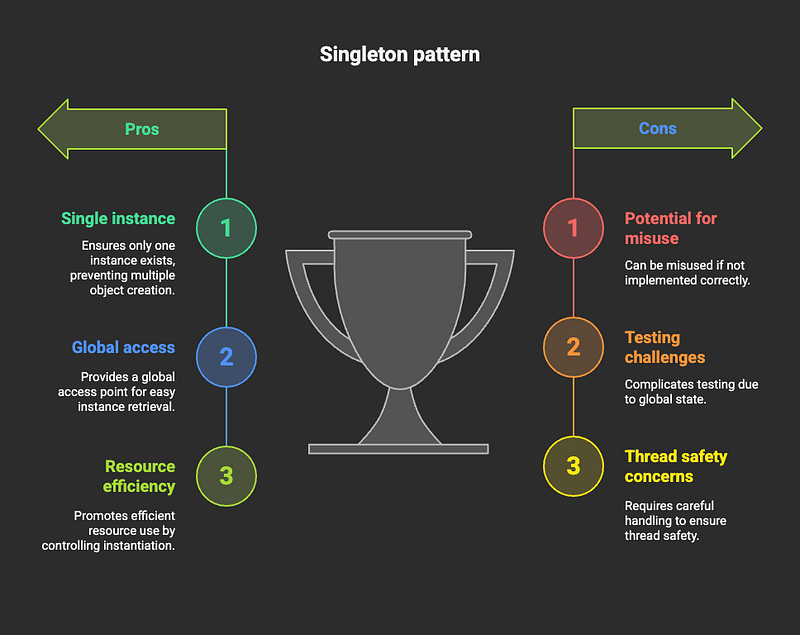
TheSingleton Patternensures that a class hasonly one instancein the JVM and provides aglobal access pointto it.
Common Use Cases:
- Configuration classes (e.g.,
AppConfig) - Logging services
- Caching mechanisms
- Thread pools
- Database connection pools
Singleton is useful when:
- You want a shared resource across the app
- You want to control access to a single point of truth
🧱 The Naive Singleton (Thread-Unsafe)
public class AppConfig { private static AppConfig instance; private AppConfig() {} public static AppConfig getInstance() { if (instance == null) { instance = new AppConfig(); } return instance; }}
❌ Problem:
- This implementation isnot thread-safe. If multiple threads call
getInstance()at the same time, it can create multiple instances. - This breaks the singleton guarantee.
🔐 Synchronized Method (Thread-Safe but Slower)
public class AppConfig { private static AppConfig instance; private AppConfig() {} public static synchronized AppConfig getInstance() { if (instance == null) { instance = new AppConfig(); } return instance; }}
✅ Thread-safe
❌ Performance hit:
- Every call to
getInstance()acquires a lock, even after the instance is initialized.
Use only in low-concurrency scenarios or educational demos.
⚡ Double-Checked Locking (with volatile)
public class AppConfig { private static volatile AppConfig instance; private AppConfig() {} public static AppConfig getInstance() { if (instance == null) { synchronized (AppConfig.class) { if (instance == null) { instance = new AppConfig(); } } } return instance; }}
✅ Thread-safe
✅ Lazy-loaded
✅ High-performance
Whyvolatile?
**Withoutvolatile, the JVM might reorder instructions due to optimizations. This could result in a thread seeing apartially constructed object**.
By marking the instance asvolatile, you prevent that reordering and guarantee full object construction visibility across threads.
💡 Static Holder Class (Bill Pugh Singleton)
public class AppConfig { private AppConfig() {} private static class Holder { private static final AppConfig INSTANCE = new AppConfig(); } public static AppConfig getInstance() { return Holder.INSTANCE; }}
✅ Thread-safe
✅ Lazy-loaded
✅ Nosynchronized, novolatile
JVM Classloading Guarantees:
Holderclass is not loaded untilgetInstance()is called.- JVM ensures thread-safe loading of classes.
This is arguably thecleanest and most efficientSingleton pattern in Java.
🧾 Enum Singleton (Joshua Bloch’s Favorite)
public enum AppConfig { INSTANCE; public void doSomething() { // Your logic here }}
✅ Thread-safe
✅ Lazy-loaded by JVM
✅ Serialization-proof
✅ Reflection-proof
✅ Minimal code, maximal safety
Why this works:
- Java ensures that any enum value is instantiated only once in the JVM.
- Enum values areinherently serializable.
- The Java language specification guarantees that enum constants arenot susceptible to reflection attacks.
✅ Recommended by Joshua Bloch (author ofEffective Java) as the safest and most concise Singleton implementation.
Downside:
- Youcannot lazy-load logicunless you’re okay with early class loading.
- Slightly less flexible in design compared to class-based variants.
🚀 Eager Initialization (Anti-pattern in Some Cases)
public class AppConfig { private static final AppConfig instance = new AppConfig(); private AppConfig() {} public static AppConfig getInstance() { return instance; }}
✅ Thread-safe
❌ Not lazy-loaded
- Memory is consumed even if the instance is never used.
- Useful only if you are 100% sure the singleton will be used.
🧠 When to Use Which Singleton?
🤔 Reflect & Apply — Questions for You:
If you can answer these, you’ve truly understood the Singleton pattern:
- What happens if
volatileis removed from a double-checked locking Singleton? - Why do we check
if (instance == null)twicein that pattern? - How does the JVM guarantee thread-safety with the static holder pattern?
- What are the dangers of using Singleton recklessly in large systems?
- Which Singleton variant would you use for a configuration loader that may or may not be used at runtime?
Take a few minutes. Think through them. If you’re unsure — scroll back up and re-read the explanations.
🫰 Final Thoughts
The Singleton pattern is deceptively simple. Many engineers fall into the trap of using it naively, turning their systems into a multithreaded mess.
In modern Java, your best bets are:
- Static Holderfor clean, lazy, thread-safe instantiation
- Double-Checked Lockingwhen you need explicit low-level control
Avoid eager singletons unless youmustload it upfront. And never use non-thread-safe variants in real-world code.
📌 Bonus: Singleton is Not Always a Good Idea
Singletons areglobal state.
Overusing them:
- Destroys testability
- Introduces hidden dependencies
- Encourages tight coupling
Use themonly when a single shared instance is truly necessary.
📉 Enjoyed This?
If this helped you level up your design pattern game:
🖐 Clap a few times to show support
💬 Drop a comment: Was this clear? Did you learn something new?
👥 Follow me for upcoming deep-dives on:
- Strategy Pattern— Dependency Injection’s Secret Weapon
- Observer Pattern— Event-Driven Systems Done Right
- Factory & Abstract Factory— Code That Builds Code
Let’s master software design — one pattern at a time.
Happy coding! ✨