🕸️ Coordination: Making Threads Work Together, Not Collide
Welcome to Pillar 4 of the Concurrency & Multithreading: The Ultimate Engineer’s Bible series.
🕸️ Coordination: Making Threads Work Together, Not Collide
Welcome to Pillar #4 of theConcurrency & Multithreading: The Ultimate Engineer’s Bibleseries.
🔗← Previous: Atomicity• 🔗 →Next: Task Management*
🔝*Parent Blog: The Ultimate Concurrency & Multithreading Guide
Concurrency without coordination is chaos.
Imagine an orchestra with no conductor. Each musician plays well, but no one playstogether.
That’s your multithreaded application without coordination:beautiful components colliding in dissonance.
Coordination is about orchestrating threads tocommunicate,synchronize, andwaitfor each other — not out of necessity, but out ofdesign.
✅ Read for free:Coordination: Making Threads Work Together, Not Collide*
If it helped you, clap once. If it helped a lot, clap more. That’s how it reaches others too.*
🎯 What is Thread Coordination?
It’s when one thread says:
“Hey, I’m done. You can go now.”
Or,
“Wait here until we all reach this point.”
Coordination solves a fundamental problem:
How do threads know when it’s safe to proceed?
We use signals, barriers, semaphores, latches — the whole toolbox. Let’s go.
🧱 Level 1: Classic Monitor Methods
The very first tools Java gave us, from the Object class itself:
wait(), notify(), notifyAll()
Inside any synchronized block, you can call:
synchronized(lock) { lock.wait(); // Thread goes into waiting state lock.notify(); // Wakes up one waiting thread lock.notifyAll(); // Wakes up all waiting threads}
Used for low-level coordination. Powerful but error-prone.
Example: Producer-Consumer (Basic Version)
synchronized(queue) { while(queue.isEmpty()) { queue.wait(); } queue.remove(); queue.notify();}
Producer notify()s when it adds. Consumer wait()s when empty.
🚀 Level 2: java.util.concurrent Tools
These are the modern, safer, and scalable alternatives.
✅ CountDownLatch
Let N threads wait until a count hits zero:
CountDownLatch latch = new CountDownLatch(3);// In each threaddoWork();latch.countDown();// Main threadlatch.await(); // Wait until count reaches 0
Used in test setups, initialization barriers, microservice orchestration.
🔁 CyclicBarrier
Unlike CountDownLatch, this is reusable. All threads wait until everyone arrives.
CyclicBarrier barrier = new CyclicBarrier(3, () -> { System.out.println("All parties arrived");});barrier.await(); // Each thread calls this
Perfect for iterative algorithms, like MapReduce or parallel simulations.
🔐 Semaphore
Classic concurrency control. Allows N threads into a critical section.
Semaphore semaphore = new Semaphore(3);semaphore.acquire();try { // access shared resource} finally { semaphore.release();}
Use this when you want to throttle access — e.g., API rate limits, resource pools.
🔄 Exchanger
For two threads to exchange data directly.
Exchanger<String> exchanger = new Exchanger<>();String response = exchanger.exchange("Request");
Rare but useful when you want ahandshakemechanism.
📆 Phaser
A more flexible CyclicBarrier with phase control.
Used when you don’t know the exact number of threads in advance or want dynamic phase progression.
Phaser phaser = new Phaser(3);phaser.arriveAndAwaitAdvance(); // Wait for phase
🧱 Blocking Queues: The Producer-Consumer Kings
Forget reinventing the wheel. Use these:
- BlockingQueue
- SynchronousQueue
- DelayQueue
These handle coordinationunder the hood. No need to call wait() or notify() manually.
Example:
BlockingQueue<String> queue = new ArrayBlockingQueue<>(10);producerThread -> queue.put("data");consumerThread -> queue.take();
It will block when full/empty. Clean, robust, production-grade.
🧘 Analogy: The Factory Floor
Imagine a factory with:
- Workers (threads)
- A conveyor belt (queue)
- A supervisor (barrier)
Each worker puts items on the belt. Others take them off.
The supervisor waits for all workers to finish a step before advancing to the next.
That’s coordination.
Youcouldyell across the factory floor (wait/notify), but it’s better to use signals, gates, and indicators (latches/barriers/queues).
😱 Bonus Tools
These are simple, often underestimated:
- join() — Wait for another thread to finish:
thread1.start();thread1.join(); // Wait for it to finish
- sleep(ms) — Pause execution for a fixed time
- yield() — Hint to scheduler: “Let someone else run”
⚠️ Pitfalls to Avoid
- Don’t call wait() outside synchronized blocks — you’ll get IllegalMonitorStateException.
- Always match wait() with notify() or notifyAll().
- Be careful with missed signals — if you notifybeforewait, the thread will wait forever.
- Avoid manual coordination if you can use CountDownLatch, Semaphore, or queues.
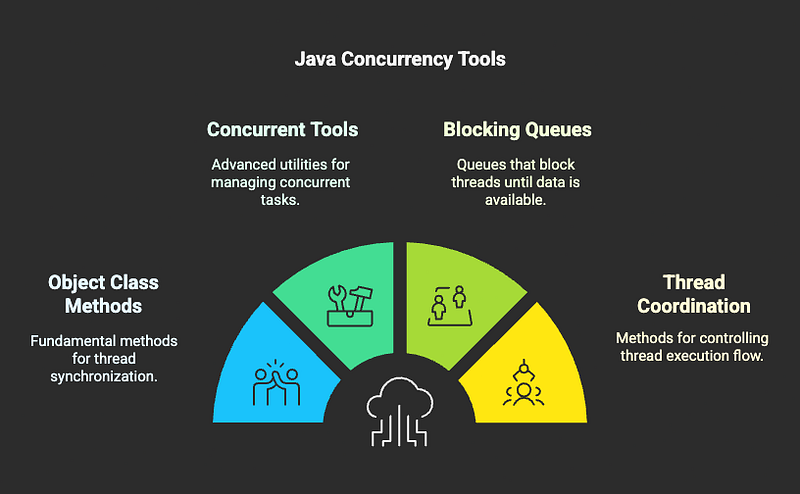
🧠 Recap: Your Coordination Toolbox
- Low-level: wait(), notify(), notifyAll()
- Blocking coordination: CountDownLatch, CyclicBarrier, Phaser
- Resource control: Semaphore
- Producer/Consumer: BlockingQueue, SynchronousQueue
- Thread utilities: join(), sleep(), yield()
🤔 Let’s Make It Interactive: Your Turn
Now that you’ve mastered thread coordination, think about this:
- Have you ever run into a coordination bug in a real-world project?
- Which coordination tool do you reach for most often — and why?
- Ever replaced wait/notify with a more modern solution like CountDownLatch or Phaser?
- How would you coordinate hundreds of threads doing parallel database writes?
💬Drop your answers in the comments — I read every one of them.
🧭 Series Navigation
- 🔝Parent Blog: The Ultimate Concurrency & Multithreading Guide
- ⬅️Previous: Atomicity
- ➡️Next: Task Management
You’ve now learned toorchestrate threads like a symphony— no missed notes, no chaos.
🛠️ Show Your Support
If this post brought you clarity, saved you hours of Googling, or challenged the way you think:
- 👏Clapto support the effort (you can hit it up to 50 times on Medium).
- 🔁Shareit with a fellow engineer or curious mind.
- 💬Commentwith questions, feedback, or requests — I read every one.
- 📩Requesta topic you’d like covered next.
- ⭐Followto stay ahead as new deep-dive posts drop.