⚔️ Atomicity: Your Final Defense Against Race Conditions
Welcome to Pillar 3 of the Concurrency & Multithreading: The Ultimate Engineer’s Bible series.
⚔️ Atomicity: Your Final Defense Against Race Conditions
Welcome to Pillar #3 of theConcurrency & Multithreading: The Ultimate Engineer’s Bibleseries.
🔗← Previous: Visibility• 🔗 →Next: Coordination*
🔝*Parent Blog: The Ultimate Concurrency & Multithreading Guide
“Two threads walk into a bar. One increments a counter. The other resets it. The bar burns down. Nobody knows why.” — Ancient concurrency proverb.
Visibility isn’t enough. You canseethe data — great. But what iftwo threads update it at the same time?
That’s the real war:race conditions.
Atomicity means:
An operation is indivisible. It either happens fully or not at all.
No other thread can peek in while it’s halfway done. You need atomicity to ensure correctness.
✅ Read for free:Atomicity: Your Final Defense Against Race Conditions*
If it helped you, clap once. If it helped a lot, clap more. That’s how it reaches others too.*
🧠 The Classic Problem: count++
Let’s break down what seems like a harmless line:
count++;
This isnotatomic. It expands to:
- Read count
- Add 1
- Write back
Now imagine two threads doing this simultaneously.
They both read count = 5, both compute 6, both write 6.
Expected: 7
Reality: 6
Boom. Race condition.
🛡️ Solution 1: Lock Everything
synchronized(lock) { count++;}
Sure, this works. But you’re back to blocking, locking, andslowing everything down.
Can we do better?
⚙️ Solution 2: Use Atomic Classes
Java gives youlock-free, thread-safe primitives with built-in atomicity.
Meet your new weapons:
- AtomicInteger
- AtomicLong
- AtomicBoolean
- AtomicReference
Example
AtomicInteger count = new AtomicInteger(0);count.incrementAndGet(); // Atomic. Thread-safe.
You getvisibility,atomicity, andperformance. No explicit locks.
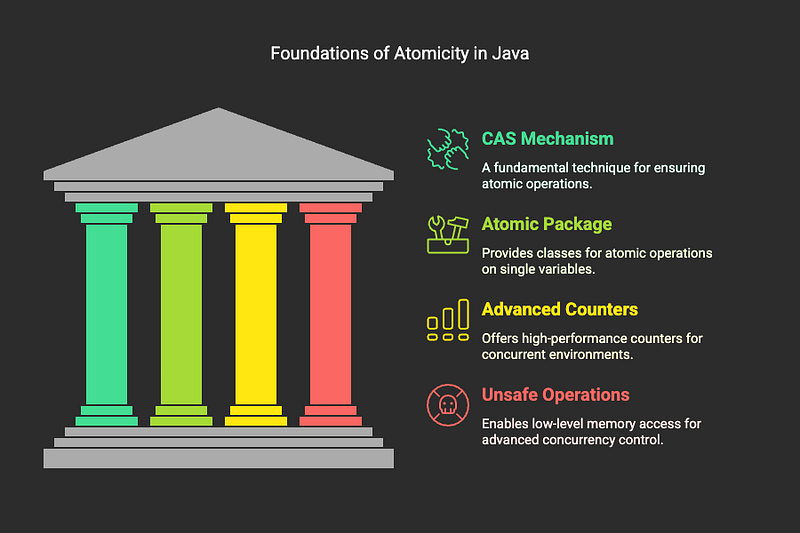
🧬 Behind the Scenes: CAS (Compare-And-Swap)
At the core of all this is a CPU-level operation calledCAS.
It works like this:
“Hey memory, if the value is still 5, change it to 6.
If someone already changed it, I’ll retry.”
It’s aloopthat keeps retrying until it succeeds.
This is what powers compareAndSet():
AtomicInteger count = new AtomicInteger(5);boolean updated = count.compareAndSet(5, 6);
If the value is still 5, it gets updated to 6. If not, the thread can retry.
No locks. No blocking. Just raw CPU-backed atomic ops.
🧘 Analogy: The Post-It Note on a Fridge
Think of a shared fridge with a post-it note saying “Milk left: 1 bottle.”
Thread A reads the note and goes to add 1 bottle.
Thread B reads the same note and also adds 1 bottle.
They both update the note to “2”. But there’s actually3now.
With CAS:
Thread A says:
“If it still says 1, change it to 2.” ✅ Success
Thread B says:
“If it still says 1, change it to 2.” ❌ Fail — someone changed it
Thread B retries:
“Now it’s 2 — change it to 3.” ✅ Success
Everyone wins. That’s atomicity with CAS.
🧪 Useful Atomic Methods
These are gold in any multithreaded context:
- get() — Fetch the current value
- set(x) — Overwrite value
- incrementAndGet() — Atomically add 1 and return
- compareAndSet(expected, update) — CAS magic
These don’t need synchronized, and they’reextremely performantunder high contention.
⚙️ LongAdder and DoubleAccumulator
When you havemassive thread counts, even AtomicInteger can become a bottleneck due to CAS retry loops.
UseLongAdderorDoubleAccumulator:
LongAdder adder = new LongAdder();adder.increment(); // Very fast under high concurrency
Instead of one counter, they use multiple cells — reducing contention.
You only get the final value when you call sum().
🧨 sun.misc.Unsafe — The Forbidden Knowledge
Deep inside Java, there’s a class called Unsafe. It lets you:
- Allocate memory manually
- Manipulate memory addresses
- Perform CAS directly
It’s what backs all the atomic classes.
You shouldnever use it directlyunless you’re building concurrency primitives. But knowing it exists? That’s next-level awareness.
👣 Common Pitfalls
- Compound operations(if (x == 5) x++) are still dangerous — use compareAndSet.
- Don’t mix Atomic* types with normal int — you lose the atomicity.
- CAScan fail repeatedlyunder heavy contention — beware the spin loop.
🔥 Recap: What You Must Remember
- count++ is not atomic
- synchronized works, but blocks
- Atomic* classes give you lock-free atomicity
- compareAndSet() is the key to concurrency without locks
- Use LongAdder for high-performance counting
- Know that Unsafe exists — but don’t use it lightly
🛤️ What’s Next?
You’ve mastered atomicity — the backbone of any correct concurrent system.
🔜Pillar #4: Coordination— where we make threads workwitheach other, notagainst.
🧭 Series Navigation
- 🔝Parent Blog: The Ultimate Concurrency & Multithreading Guide
- ⬅️Previous: Visibility
- ➡️Next: Coordination
🛠️ Show Your Support
If this post brought you clarity, saved you hours of Googling, or challenged the way you think:
- 👏Clapto support the effort (you can hit it up to 50 times on Medium).
- 🔁Shareit with a fellow engineer or curious mind.
- 💬Commentwith questions, feedback, or requests — I read every one.
- 📩Requesta topic you’d like covered next.
- ⭐Followto stay ahead as new deep-dive posts drop.