🧪 Use Temporary Tables for Intermediate Results
Temporary tables are special tables that exist temporarily during a session or transaction. They are perfect for breaking down complex queries into manageabl...
🧪 Use Temporary Tables for Intermediate Results
💡 What Are Temporary Tables?
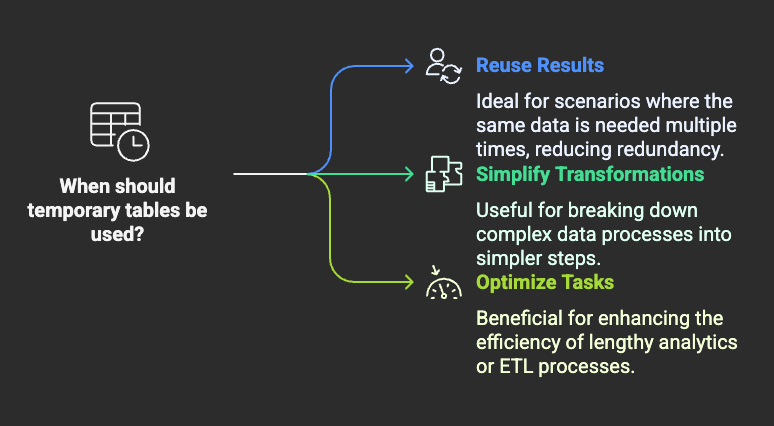
Temporary tablesare special tables that exist temporarily during a session or transaction. They are perfect for breaking down complex queries into manageable steps and storing intermediate results, especially when:
- You’re reusing the same result multiple times in a query.
- You want to simplify multi-step data transformations.
- You’re optimizing long-running analytics or ETL tasks.
They can dramatically improve performance by avoiding repeated subquery execution and enabling indexing on intermediate results.
⚡ Benefits of Using Temporary Tables
🧱 Creating Temporary Tables with Indexes and Constraints
Here’s how to create a temp table that mirrors the structure of an existing table (including indexes):
🐘 PostgreSQL
-- Create temp table like the original, with structure onlyCREATE TEMP TABLE temp_orders (LIKE orders INCLUDING ALL);-- Add extra indexes or constraints if neededCREATE INDEX idx_temp_orders_customer_id ON temp_orders(customer_id);
🧂 SQL Server
-- Create temp tableSELECT * INTO #temp_orders FROM orders WHERE 1=0;-- Add indexCREATE NONCLUSTERED INDEX idx_customer ON #temp_orders(customer_id);
🐬 MySQL
CREATE TEMPORARY TABLE temp_orders LIKE orders;-- Add index manuallyALTER TABLE temp_orders ADD INDEX idx_customer (customer_id);
🔁 Example Use Case: Breaking Down Complex Query
Let’s say you’re analyzing top-performing customers over multiple filters and transformations.
Step 1: Store Filtered Data
CREATE TEMP TABLE high_value_orders ASSELECT * FROM ordersWHERE order_total > 500;
Step 2: Aggregate Data
SELECT customer_id, COUNT(*) AS total_ordersFROM high_value_ordersGROUP BY customer_idORDER BY total_orders DESC;
This approach avoids recalculating the same WHERE clause repeatedly.
📌 Best Practices
- Prefix with temp_ or use naming conventions like # (SQL Server).
- Drop them explicitly if used in long-running sessions.
- Index wisely: only add indexes if the temp table will be queried repeatedly or joined.
🧠 Pro Tip
In some DBMS (like PostgreSQL),CTEsorWITH clausesmay work better for small in-memory intermediate steps. But for large datasets or multi-step operations, temporary tables are far more performant.
✅ Final Thoughts
Temporary tables are more than just a development trick — they’re a powerful query optimization technique. By using them to store and index intermediate results, you can simplify your queries, boost performance, and create scalable solutions for complex data workflows.
Let me know if you’d like an image or performance comparison added!