🚀 Boost Performance with Memory-Optimized Tables
When milliseconds matter, traditional disk based tables might not be fast enough. That’s where memory optimized tables come into play. Designed for ultra low...
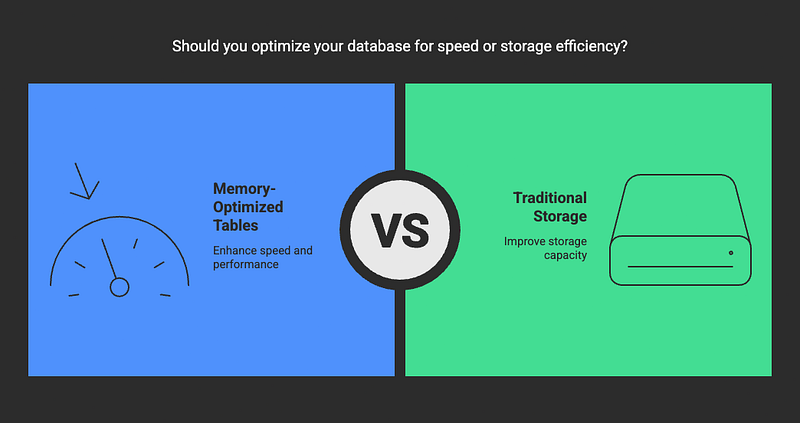
When milliseconds matter, traditional disk-based tables might not be fast enough. That’s wherememory-optimized tablescome into play. Designed for ultra-low latency and high-throughput workloads, they leverage in-memory storage to deliver exceptional performance.
🔍 What Are Memory-Optimized Tables?
Memory-optimized tables are fully stored in memory rather than on disk. They are a feature available in some modern relational databases likeSQL Server (In-Memory OLTP)andMySQL with MEMORY engine.
These tables offer:
- Faster reads/writes🚀
- Optimized concurrency
- Reduced latching and blocking
🧠 When Should You Use Them?
⚙️ Supported Platforms
🧪 How to Create a Memory-Optimized Table
✅ SQL Server Example
CREATE TABLE OrdersMemOptimized( OrderID INT NOT NULL PRIMARY KEY NONCLUSTERED, ProductName NVARCHAR(100), Quantity INT)WITH (MEMORY_OPTIMIZED = ON, DURABILITY = SCHEMA_AND_DATA);
✅ MySQL Example
CREATE TABLE CacheData ( id INT PRIMARY KEY, value VARCHAR(255)) ENGINE=MEMORY;
⚠️ Important Considerations
🛠️ Performance Comparison
🧩 Real-World Example: IoT Sensor Table
Traditional Table (Disk-Based)
CREATE TABLE SensorData ( SensorID INT, ReadingValue FLOAT, ReadingTime DATETIME);
High latency observed when inserting thousands of rows per second.
Memory-Optimized Version
CREATE TABLE SensorDataMem ( SensorID INT, ReadingValue FLOAT, ReadingTime DATETIME, PRIMARY KEY (SensorID, ReadingTime))WITH (MEMORY_OPTIMIZED = ON, DURABILITY = SCHEMA_ONLY);
💡Results:
- Insert throughput improved by3–5x
- CPU usage dropped by20%
- Real-time dashboard updates became smoother
✅ Best Practices
- Use forhotortransientdata.
- Combine withnative compiled stored proceduresfor max performance (SQL Server).
- Avoid overloading memory — monitor and manage RAM usage.
🏁 Conclusion
Memory-optimized tables are a game changer for performance-critical workloads. Whether you’re building a real-time system, high-speed cache, or ingestion pipeline — leveraging memory over disk can deliver massive speed improvements.
Use them wisely, benchmark thoroughly, and watch your queries fly! 🚀