🧩 Use CTEs (Common Table Expressions) for Complex Queries
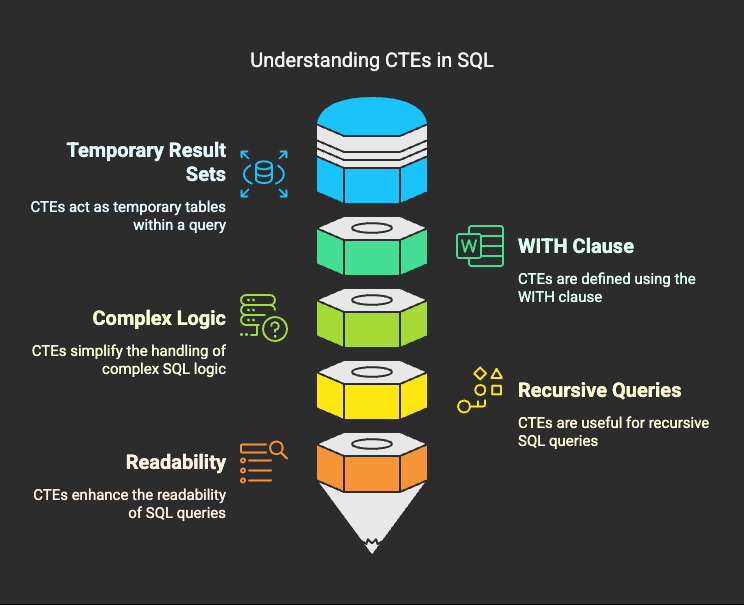
Common Table Expressions (CTEs) are temporary result sets defined within the execution scope of a single SQL statement. CTEs are written using the WITH claus...
🧩 Use CTEs (Common Table Expressions) for Complex Queries
💡 What Are CTEs?
Common Table Expressions (CTEs)are temporary result sets defined within the execution scope of a single SQL statement. CTEs are written using the WITH clause and are especially useful when working with complex logic, recursive queries, or when improving query readability.
✅ Why Use CTEs?
🧱 Syntax
WITH cte_name AS ( SELECT ...)SELECT * FROM cte_name;
🔍 Example 1: Simplify a Complex Join
Before (nested subquery):
SELECT o.customer_id, COUNT(*) AS total_ordersFROM ( SELECT * FROM orders WHERE order_total > 500) oGROUP BY o.customer_id;
After (using CTE):
WITH high_value_orders AS ( SELECT * FROM orders WHERE order_total > 500)SELECT customer_id, COUNT(*) AS total_ordersFROM high_value_ordersGROUP BY customer_id;
✅Cleaner and more maintainable!
🔁 Example 2: Recursive CTE for Hierarchical Data
Use CTEs to query tree-like data, such as organization charts or category hierarchies.
WITH RECURSIVE org_chart AS ( SELECT id, name, manager_id FROM employees WHERE manager_id IS NULL UNION ALL SELECT e.id, e.name, e.manager_id FROM employees e INNER JOIN org_chart oc ON e.manager_id = oc.id)SELECT * FROM org_chart;
This will recursively return all employees in the hierarchy starting from the top-level manager.
🚀 Performance Considerations
- CTEsdo not always materializethe result set (depends on DB engine). They may behave like inline views.
- Forvery large datasets, usingtemp tablesmight offer better performance than CTEs if reused across multiple queries.
- In PostgreSQL, theMATERIALIZEDkeyword can be used to force materialization:
WITH MATERIALIZED filtered_orders AS ( SELECT * FROM orders WHERE status = 'delivered')SELECT * FROM filtered_orders;
⚖️ CTEs vs. Subqueries vs. Temp Tables
✅ Final Thoughts
CTEs are a powerful and clean way to break down complex logic in SQL. They make your queries more readable, easier to debug, and can support advanced features like recursion. When used wisely, they’re a game-changer for both writing and optimizing queries.