🎯 Optimize for Specific Workloads: OLTP vs OLAP
Not all databases are used the same way. Knowing whether your workload is transactional (OLTP) or analytical (OLAP) is essential for optimizing performance, ...
🎯 Optimize for Specific Workloads: OLTP vs OLAP
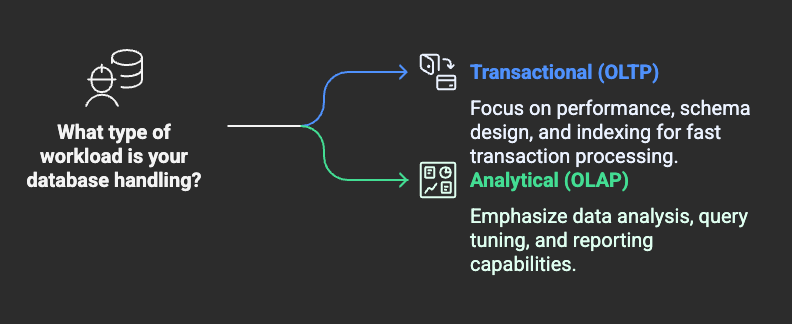
Not all databases are used the same way. Knowing whether your workload istransactional (OLTP)oranalytical (OLAP)is essential for optimizing performance, schema design, indexing strategy, and query tuning.
🔍 What Are OLTP and OLAP?
⚙️ Tuning Strategies for OLTP Workloads
1. ✅ Use Normalized Schema
To reduce data redundancy and maintain integrity.
2. ⚡ Keep Transactions Short and Fast
Avoid holding locks longer than necessary.
3. 📏 Use Narrow Indexes
Only include columns necessary for lookups to reduce index maintenance overhead.
4. 🧼 Optimize Locking and Concurrency
Use row-level locks, isolation levels like READ COMMITTED.
5. 💽 Tune for Write Performance
Use faster storage and batch writes if possible.
📊 Tuning Strategies for OLAP Workloads
1. ⭐ Use Denormalized Schema
Star or snowflake schemas simplify and speed up aggregations and joins.
2. 📥 Leverage Materialized Views
Precompute and cache heavy aggregations.
3. 📦 Partition Large Tables
Improves performance by scanning only relevant partitions.
4. 🧠 Use Columnar Storage (if available)
Columnar formats like in Amazon Redshift, ClickHouse, or PostgreSQL with cstore_fdw optimize read-heavy queries.
5. 📚 Pre-Aggregate Data
Store intermediate aggregates to reduce runtime computation.
🔄 Example: Same Data, Different Workloads
-- OLTP: A simple update in a banking appUPDATE accountsSET balance = balance - 100WHERE account_id = 123;-- OLAP: Monthly revenue reportSELECT region, SUM(amount) AS total_revenueFROM transactionsWHERE transaction_date BETWEEN '2024-01-01' AND '2024-01-31'GROUP BY region;
📈 Performance Impact
💡 Pro Tip
Don’t try to force OLTP workloads into OLAP databases and vice versa. Some modern databases likePostgreSQL,SQL Server, andSnowflakecan handle mixed workloads —but optimization still matters!
🧠 Final Thoughts
Understanding your workload type is foundational to performance tuning. By aligning schema design, indexes, and query strategies with the nature of your workload, you ensure the database runs smoothly and efficiently — whether you’re processing transactions or generating business insights.