🧠 Use Stored Procedures and Functions for Repetitive Tasks
When your application performs repetitive database operations — like inserting logs, validating data, or executing complex calculations — stored procedures a...
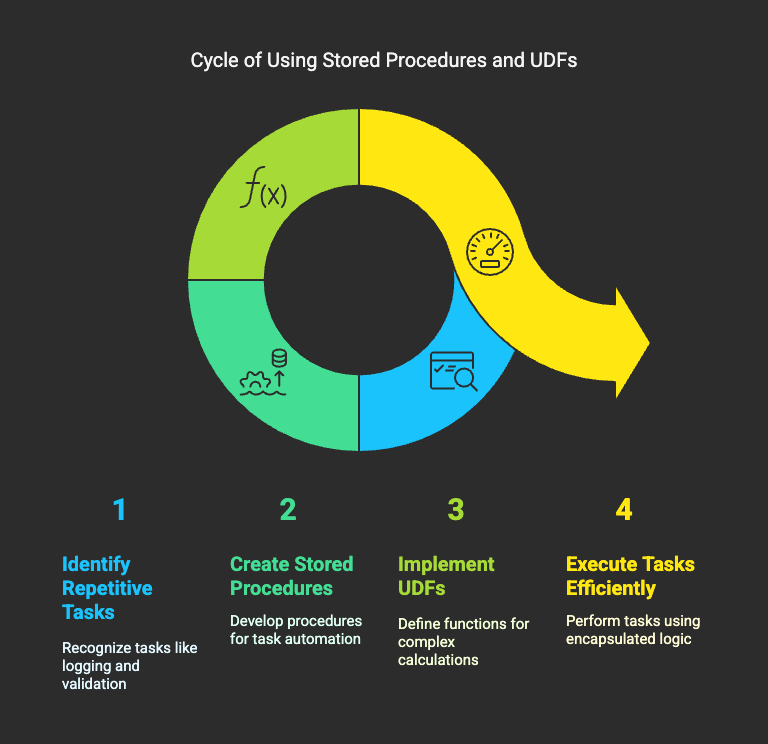
🧠 Use Stored Procedures and Functions for Repetitive Tasks
🚀 Why Use Stored Procedures and Functions?
When your application performs repetitive database operations — like inserting logs, validating data, or executing complex calculations —stored proceduresanduser-defined functions (UDFs)offer a powerful way to encapsulate logic and improve performance.
✅ Benefits:
- Performance Boost: Parsed and compiled once, reused many times.
- Code Reusability: Centralize business logic in one place.
- Maintainability: Changes require updates in one place.
- Security: Can grant execution rights without exposing data structure.
🔧 Stored Procedure vs Function
📘 Example: Stored Procedure for Bulk Logging
CREATE PROCEDURE log_event( IN user_id INT, IN action VARCHAR(100), IN log_time TIMESTAMP)BEGIN INSERT INTO event_logs (user_id, action, log_time) VALUES (user_id, action, log_time);END;
📥Usage:
CALL log_event(42, 'LOGIN_SUCCESS', NOW());
🧮 Example: User-Defined Function for Tax Calculation
CREATE FUNCTION calculate_tax(price DECIMAL(10,2))RETURNS DECIMAL(10,2)DETERMINISTICBEGIN RETURN price * 0.18;END;
📥Usage in a query:
SELECT product_name, calculate_tax(price) AS taxFROM products;
🛠 Real-World Use Case: Report Generation
Imagine generating daily sales summaries used in dashboards:
✅Without stored procedure: Requires repeated complex queries in application code.
✅With stored procedure:
CREATE PROCEDURE daily_sales_summary(IN report_date DATE)BEGIN SELECT product_id, SUM(quantity) AS total_sold FROM sales WHERE sale_date = report_date GROUP BY product_id;END;
Now just call it:
CALL daily_sales_summary(CURRENT_DATE - INTERVAL 1 DAY);
📈 Performance Benefit
- 🔁Reusability: One-time compilation and execution plan caching
- ⚡Less network overhead: Only call procedure name, not whole query
- 🔐Security: Avoid exposing raw tables directly to application layer
🔒 Best Practices
- ✅ Use parameters instead of hardcoded values
- ✅ Handle exceptions inside procedures
- ✅ Keep functions deterministic when possible
- ✅ Avoid too much business logic in stored procedures (keep it modular)
💡 Final Thoughts
Stored procedures and user-defined functions bring structure, security, and performance benefits to SQL-heavy applications. Use them for routine operations, encapsulate logic, and keep your database logic DRY (Don’t Repeat Yourself).