🔗 Avoid Too Many Joins in a Single Query
Joining multiple tables in a single query is common in relational databases, but excessive joins — especially on large datasets — can lead to:
🔗 Avoid Too Many Joins in a Single Query
🤯 Why Too Many Joins Can Hurt Performance
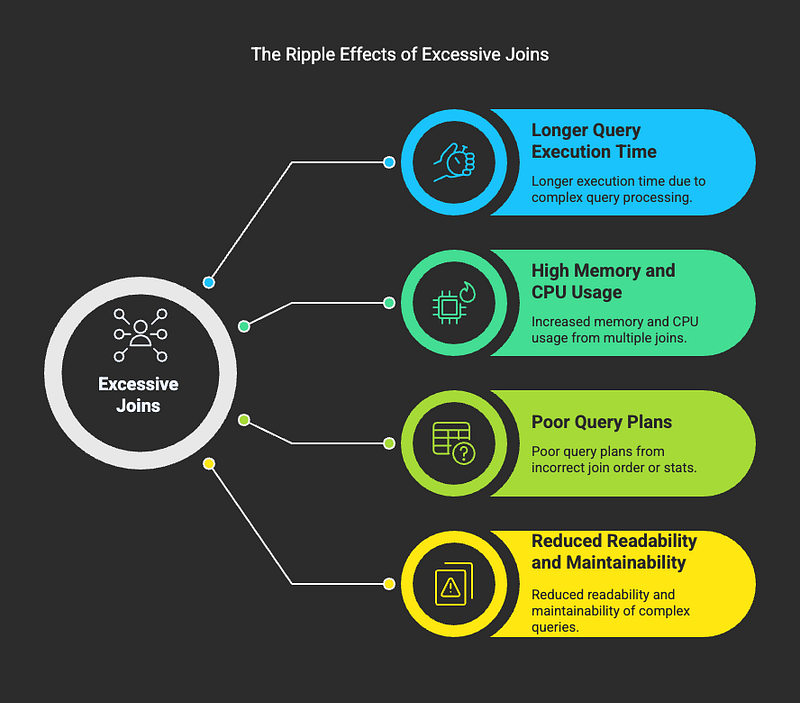
Joining multiple tables in a single query is common in relational databases, butexcessive joins— especially on large datasets — can lead to:
- 🔄Longer query execution time
- 💥High memory and CPU usage
- ❌Poor query plans due to incorrect join order or bad stats
- 📉Reduced readability and maintainability
Every additional join increases the complexity of the execution plan and expands the search space for the query optimizer.
🛑 Common Symptoms of Over-Joined Queries
- Query takes a long time to execute or times out
- Disk I/O spikes or CPU usage maxes out
- Execution plan has nested loop joins everywhere
- Output contains redundant or null data
🧠 Example: Query with Too Many Joins
SELECT o.id, c.name, p.product_name, s.shipment_date, r.region_nameFROM orders oJOIN customers c ON o.customer_id = c.idJOIN products p ON o.product_id = p.idJOIN shipments s ON o.shipment_id = s.idJOIN regions r ON c.region_id = r.idJOIN agents a ON c.agent_id = a.idJOIN invoices i ON o.invoice_id = i.id-- and more...WHERE o.status = 'delivered';
While this might work, it can become a bottleneck for performance and harder to troubleshoot.
🧰 Strategies to Improve
✅ 1. Break into Smaller Logical Units Using CTEs
Split the query into logical blocks:
WITH customer_orders AS ( SELECT o.id, o.customer_id, o.product_id, o.shipment_id FROM orders o WHERE o.status = 'delivered'),order_products AS ( SELECT co.id, p.product_name FROM customer_orders co JOIN products p ON co.product_id = p.id)SELECT * FROM order_products;
Improves readability and makes the query easier to debug.
✅ 2. Fetch Only What You Need
Avoid SELECT * — retrieve only required columns to reduce the data load and memory usage.
✅ 3. Use Indexed Columns in Joins
Ensure foreign keys and commonly joined columns are indexed.
Create index for join columnsCREATE INDEX idx_orders_customer_id ON orders(customer_id);
✅ 4. Pre-Aggregate or Use Temp Tables
If possible, pre-join data or use temporary tables for intermediate results.
CREATE TEMP TABLE recent_orders ASSELECT * FROM orders WHERE order_date > CURRENT_DATE - INTERVAL '30 days';-- Later use this temp table in joins
✅ 5. Reevaluate Business Requirements
Sometimes, not all joins are necessary. Double-check with stakeholders — do they need all that data?
📊 Performance Example
🧪 Final Thoughts
While joins are fundamental to relational databases, too many of them in one query can hurt both performance and maintainability. Keep your queries lean and focused. Use CTEs, temp tables, and selective columns to make your SQL fast and clean.