🧠 The Ultimate Java Concurrency & Multithreading Roadmap (Deep, Transferable, Timeless)
Master the 9 Pillars Every Engineer Must Know
🧠 The Ultimate Java Concurrency & Multithreading Roadmap (Deep, Transferable, Timeless)
Master the 9 Pillars Every Engineer Must Know
You’re not here for fluff. You’re here because you want to master concurrency and multithreading like your engineering career depends on it — because it does.
This isnot just a blog. This is themind map, thenorth star, thepillarsof modern concurrent programming.
Whether you’re writing in Java, C++, Rust, Go, Python, or JavaScript —this is it.
These 9 pillarstranscend languages, libraries, and frameworks.Master these, and you will dominate any concurrency paradigm.
🔥 Why This Blog Exists
Let’s be clear — this is not a regurgitation of the Java docs or a paraphrased version of some Stack Overflow thread.
This blog is the result of months of ruthless research, battle-tested debugging, and cross-language insights — centered aroundJava, but deeply inspired by:
- C++11’s atomic ordering
- Golang’s CSP-style coordination
- Rust’s ownership safety model
- Python’s GIL-cooperative concurrency
- JavaScript’s async event loop
Despite syntax differences, I realized theconceptual foundationswere repeating.
What emerged wasa unifying model of concurrency— the 9 Pillars. Aprogrammer’s Biblefor writing safe, performant, and robust concurrent systems.
Note:This series is written in Java and for Java engineers — but the foundational concepts you’ll learn are transferable across languages. You’ll find parallels in every modern system that touches concurrency.
⚙️ Why You Must Learn These Pillars — No Matter Your Language
You may write Java today and Rust tomorrow. You may move from Spring Boot to serverless Lambda functions.
But the moment you deal with threads, cores, parallel requests, or shared memory —these 9 pillars show up.
Here’s why:
- Mutual exclusion— Ensures correctness when state is shared.
- Visibility— Guarantees other threads see your changes.
- Atomicity— Prevents race conditions at the bytecode level.
- Coordination— Lets threads talk, wait, and sync up.
- Task management— Orchestrate work efficiently with thread pools.
- Non-blocking async— Helps you scale without blocking.
- Immutability— Eliminates whole categories of bugs.
- Parallelism— Lets you scale across cores.
- Thread lifecycle— Master the states: NEW → TERMINATED.
Ignore these at your own risk.
Every crash in production, every deadlock, every flaky test that “works on my machine” — is a violation of one or more of these pillars.
📚 The Pillars (Preview)
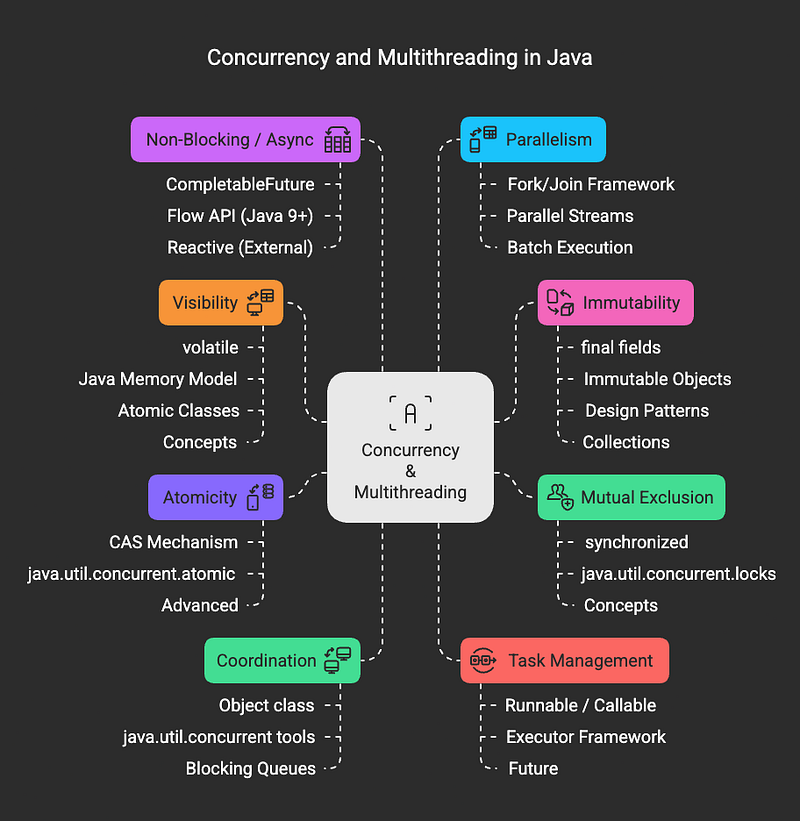
Here’s the bird’s-eye view of the mind map we’ll explore:
Concurrency & Multithreading
├── 1. Mutual Exclusion
│   └── Locking, reentrancy, intrinsic monitors
├── 2. Visibility
│   └── Volatile, memory model, happens-before
├── 3. Atomicity
│   └── Compare-and-swap, atomic primitives
├── 4. Coordination
│   └── wait/notify, latches, semaphores
├── 5. Task Management
│   └── Runnable, ExecutorService, Future
├── 6. Non-Blocking / Async
│   └── CompletableFuture, reactive streams
├── 7. Immutability
│   └── final fields, value objects, collections
├── 8. Parallelism
│   └── Fork/Join, Streams, Spliterators
└── 9. Thread Lifecycle
    └── States, interrupt, daemon, priority
This is not just a list — it’sa mental model.
While this series deep-dives into Java APIs (like synchronized, CompletableFuture, and ExecutorService), you’ll notice how these concepts echo in Go’s goroutines, Rust’s tokio, or Node.js’s event loop. That’s intentional. The goal is to build a reusable mental model.
Everything you study in concurrency maps to one or more of these buckets.
From simple locks to advanced reactive programming —it all fits here.
🧠 The Mind Map (In Detail)
Concurrency & Multithreading
├── 1. Mutual Exclusion
│   ├── synchronized
│   │   ├── Method-level
│   │   └── Block-level
│   ├── java.util.concurrent.locks
│   │   ├── Lock
│   │   │   ├── lock()
│   │   │   └── unlock()
│   │   ├── ReentrantLock
│   │   ├── ReadWriteLock
│   │   └── StampedLock (Optimistic Read)
│   └── Concepts
│       └── Reentrancy, Monitor, Intrinsic Lock
│
├── 2. Visibility
│   ├── volatile
│   ├── Java Memory Model
│   │   └── Happens-before
│   ├── Atomic Classes
│   │   ├── AtomicInteger
│   │   ├── AtomicLong
│   │   ├── AtomicBoolean
│   │   └── AtomicReference
│   └── Concepts
│       └── Cache Coherence, Reordering Prevention
│
├── 3. Atomicity
│   ├── CAS Mechanism (Compare-And-Swap)
│   ├── java.util.concurrent.atomic
│   │   ├── get(), set()
│   │   ├── compareAndSet()
│   │   └── incrementAndGet()
│   ├── Advanced Counters
│   │   ├── LongAdder
│   │   └── DoubleAccumulator
│   └── Unsafe (sun.misc.Unsafe) [low-level ops]
│
├── 4. Coordination
│   ├── Object class
│   │   ├── wait()
│   │   ├── notify()
│   │   └── notifyAll()
│   ├── java.util.concurrent tools
│   │   ├── CountDownLatch
│   │   ├── CyclicBarrier
│   │   ├── Semaphore
│   │   ├── Exchanger
│   │   └── Phaser
│   ├── Blocking Queues
│   │   ├── BlockingQueue
│   │   ├── SynchronousQueue
│   │   └── DelayQueue
│   └── Thread Coordination
│       ├── join()
│       ├── sleep()
│       └── yield()
│
├── 5. Task Management
│   ├── Runnable / Callable
│   ├── Executor Framework
│   │   ├── Executors (factory)
│   │   │   ├── newFixedThreadPool()
│   │   │   ├── newCachedThreadPool()
│   │   │   ├── newSingleThreadExecutor()
│   │   │   └── newScheduledThreadPool()
│   │   └── ExecutorService
│   │       ├── submit()
│   │       ├── shutdown()
│   │       ├── awaitTermination()
│   │       ├── invokeAll()
│   │       └── invokeAny()
│   └── Future
│       ├── get()
│       ├── cancel()
│       └── isDone()
│
├── 6. Non-Blocking / Async
│   ├── CompletableFuture
│   │   ├── supplyAsync()
│   │   ├── thenApply(), thenAccept(), thenCombine()
│   │   ├── allOf(), anyOf()
│   │   └── exceptionally(), whenComplete()
│   ├── Flow API (Java 9+)
│   │   ├── Publisher
│   │   ├── Subscriber
│   │   ├── Processor
│   │   └── Subscription
│   └── Reactive Libraries
│       ├── Project Reactor
│       └── RxJava
│
├── 7. Immutability
│   ├── final keyword
│   ├── Immutable Class Design
│   │   ├── Constructor-only state
│   │   ├── All fields final
│   │   └── No setters
│   ├── Design Patterns
│   │   ├── Builder Pattern
│   │   └── Value Object
│   └── Collections (Java 9+)
│       ├── List.of()
│       ├── Set.of()
│       └── Map.of()
│
├── 8. Parallelism
│   ├── Fork/Join Framework
│   │   ├── ForkJoinPool
│   │   ├── RecursiveTask
│   │   └── RecursiveAction
│   ├── Parallel Streams
│   │   ├── .parallelStream()
│   │   └── .map(), .reduce(), .collect()
│   ├── Spliterator (advanced)
│   └── Batch Execution
│       └── invokeAll(List<Callable<T>>)
│
└── 9. Thread Lifecycle / Management
    ├── Thread class
    │   ├── start(), run()
    │   ├── interrupt(), isInterrupted()
    │   └── setDaemon(), setPriority()
    ├── Thread States
    │   ├── NEW
    │   ├── RUNNABLE
    │   ├── BLOCKED
    │   ├── WAITING
    │   ├── TIMED_WAITING
    │   └── TERMINATED
    ├── ThreadFactory
    └── ThreadGroup (legacy)
🌐 How These Concepts Map Across Languages
🛠You’ll see these tools evolve — but the underlying problems and principles stay the same.
💡 How This Was Created — Behind The Scenes
I didn’t just lift this from a textbook.
I reverse-engineeredhow top engineers at FAANG and high-frequency trading firms think about concurrency.
I cross-referenced:
- Real-world production failures
- Core JDK, Golang, Rust, and NodeJS source code
- Research papers on memory models and synchronization
- Design docs from large-scale systems at Uber, Google, Netflix
I removed fluff. I filtered noise.
What remained werethese 9 structural concepts— recurringin every modern language and system.
🧩 What Happens Next
This is not the end — this is theframework.
Next, we willdeep-dive into each pillar— one blog post at a time.
We’ll demystify:
- Why synchronized isn’t enough
- Why volatile is misunderstood
- What CAS really does under the hood
- How to use CountDownLatch like a pro
- How CompletableFuture’s DAG model works
- Why immutability is a concurrency hack
- And much more.
Each blog will include:
- Visuals & mental models
- Java code snippets
- Cross-language examples
- Gotchas from production
- Interview-grade breakdowns
🚀 Who Is This For?
- Engineerspreparing for Google, Meta, Netflix, or high-performance backend roles
- Leads & Architectsdesigning scalable systems
- Interview candidatestired of memorizing fragmented concurrency trivia
- Anyonewho wants to buildreal, safe, and scalable concurrent systems
🧠 The One-Liner to Remember
“If you understand these 9 pillars, you can write concurrent code in any language. You will never fear threads again.”
🧭 Series Navigation
- 🔝 Parent Blog: The Ultimate Concurrency & Multithreading Guide
- ⬅️ [Previous: None — this is the first]
- ➡️Next: Mutual exclusion
📰 All Pillar Deep-Dives:
- 🔐Mutual Exclusion: The First Law of Thread Civilization 👉 Click to dive in
- 👀 Visibility: The Hidden Force That Breaks or Builds Your Code 👉 Click to explore
- ⚔️ Atomicity: Your Final Defense Against Race Conditions 👉 Read now
- 🕸️ Coordination: Making Threads Work Together, Not Collide 👉 See how it works
- 🧠 Task Management: Thread Creation is Dead, Long Live the Executor 👉 Learn the strategy
- ⚡ Non-Blocking & Async: The Future Has No wait() 👉 Understand async flows
- 🧱 Immutability — Thread Safety Without the Locks 👉 See why it’s magic
- 🧮 Parallelism — Exploiting All Cores Like a Pro 👉 Read now
- 🧵 Thread Lifecycle & Management — The Final Pillar 👉 Final piece of puzzle
🛠️ Show Your Support
If this post brought you clarity, saved you hours of Googling, or challenged the way you think:
- 👏Clapto support the effort (you can hit it up to 50 times on Medium).
- 🔁Shareit with a fellow engineer or curious mind.
- 💬Commentwith questions, feedback, or requests — I read every one.
- 📩Requesta topic you’d like covered next.
- ⭐Followto stay ahead as new deep-dive posts drop.
Let’s build real engineering wisdom — not trivia.