Demystifying == and .equals() in Java
Understanding Reference Equality, Value Equality, hashCode(), Lombok, and Records
Demystifying == and .equals() in Java
Understanding Reference Equality, Value Equality, hashCode(), Lombok, and Records
In Java, comparing objects is not as straightforward as it seems. Developers often confuse == and .equals(), and overlook the role of hashCode(), which leads to subtle bugs — especially in collections like HashMap. In this post, we’ll dissect these concepts and explore modern alternatives like Lombok and Records.
🔍 == Operator — Reference Equality
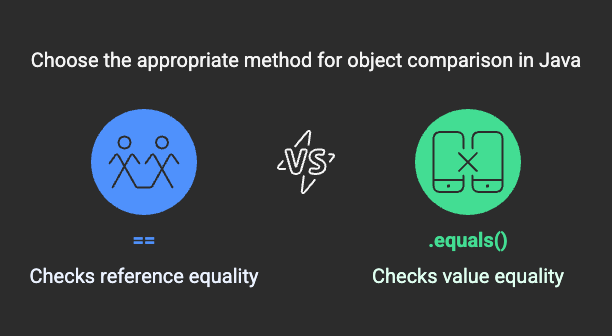
The == operator checks whethertwo object references point to the exact same memory location.
Example example1 = new Example();
Example example2 = new Example();
System.out.println(example1 == example1); // true
System.out.println(example1 == example2); // false
Even if example1 and example2 hold thesame values, == returns false because they are different objects in memory.
🔍 .equals() Method — Value Equality (When Overridden)
By default, the .equals() method in Java is inherited from Object, and its behavior is identical to == — it checksreference equality.
public class Example {
    public int id;
}
Example e1 = new Example();
e1.id = 1;
Example e2 = new Example();
e2.id = 1;
System.out.println(e1.equals(e2)); // false
But this can (and should) be overridden to compareobject contentsinstead of memory references:
public class Example {
    public int id;
    @Override
    public boolean equals(Object o) {
        if (this == o) return true;
        if (!(o instanceof Example)) return false;
        Example other = (Example) o;
        return this.id == other.id;
    }
    @Override
    public int hashCode() {
        return Objects.hash(id);
    }
}
Now:
Example e1 = new Example();
e1.id = 1;
Example e2 = new Example();
e2.id = 1;
System.out.println(e1.equals(e2)); // true
⚠️ == vs .equals() — What’s the Difference?
- == comparesobject references(memory location).
- .equals() comparesobject referencesby default.
- When overridden, .equals() can compareobject content(values).
- Only .equals() can be overridden — == cannot.
- Java collections like HashMap use .equals() and hashCode() to function properly.
🤔 Why Do We Need hashCode()?
Whenever you override .equals(), youmustalso override hashCode().
Why?
Because hash-based collections (HashMap, HashSet, etc.) use:
- hashCode() to find thebucket.
- .equals() to find theexact objectinside that bucket.
If two objects are equal by .equals(), they must have thesame hash code— that’s the contract.
Example Without hashCode Override:
Example e1 = new Example();
e1.id = 1;
Example e2 = new Example();
e2.id = 1;
System.out.println(e1.equals(e2)); // true
System.out.println(e1.hashCode()); // 9869869
System.out.println(e2.hashCode()); // 8768872
Even though equals() returns true, the hashCode() values are different. If you store e1 in a HashMap and then look up e2, it won’t be found. Bug alert!
✅ Correct hashCode Implementation
@Override
public int hashCode() {
    return Objects.hash(id);
}
This ensures that logically equal objects return the same hash and behave correctly in collections.
💥 What If You Mutate a Key?
Map<Example, String> map = new HashMap<>();
Example key = new Example();
key.id = 1;
map.put(key, "value");
// Mutate the key
key.id = 2;
// This will fail
System.out.println(map.containsKey(key)); // false
Mutating a field that affects .hashCode() breaks the map. The object “moves” to a different bucket, but the map can’t find it anymore. This is whykeys in a hash-based map must be immutable.
🛠️ Use Lombok to Avoid Boilerplate
Writing equals() and hashCode() manually is tedious and error-prone.
Lombokprovides annotations to generate them automatically:
import lombok.EqualsAndHashCode;
@EqualsAndHashCode
public class Example {
    public int id;
}
Use @Data for a full package: getters, setters, toString, equals, and hashCode.
🚀 Use Records for Cleaner, Immutable Value Classes
Java introducedrecordsin Java 14 (finalized in Java 16). Records areimmutable, concise, and perfect for DTOs and map keys.
public record Example(int id) {}
This one-liner gives you:
- Constructor
- Getters
- equals()
- hashCode()
- toString()
- Immutable fields
No Lombok, no boilerplate — modern Java at its best.
✅ Summary — When to Use What?
- Use == when you care aboutobject identity(i.e., same memory address).
- Use .equals() when comparingvalues— but remember to override it.
- Override hashCode() whenever you override .equals().
- Never usemutable objects as map keys.
- UseLombok(@EqualsAndHashCode or @Data) to reduce boilerplate.
- Preferrecordsfor clean, immutable value classes when possible.