💳 Use Proper Transaction Management for Data Integrity and Performance
In database driven applications, transactions play a critical role in maintaining data consistency , integrity , and performance . Poor transaction managemen...
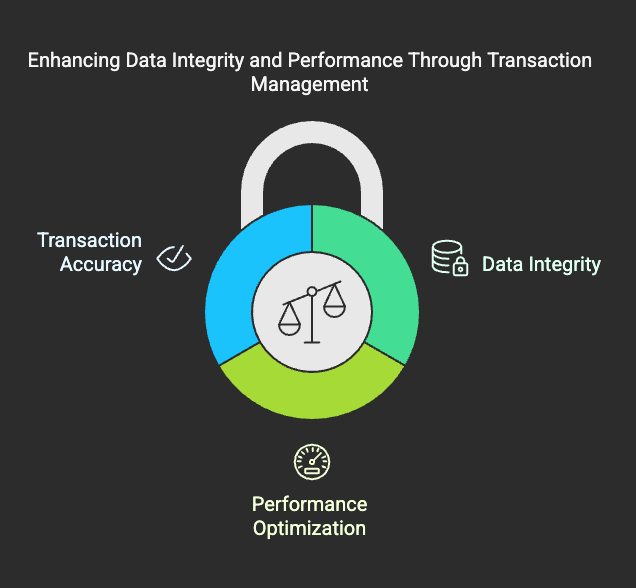
💳 Use Proper Transaction Management for Data Integrity and Performance
In database-driven applications, transactions play a critical role in maintainingdata consistency,integrity, andperformance. Poor transaction management can lead to data anomalies, locking issues, and even crashes. In this post, let’s understand how to use transactions efficiently and what best practices can significantly boost performance.
🧩 What is a Database Transaction?
Atransactionis a sequence of one or more SQL operations that are executed as a single unit of work. Eitheralloperations in a transaction are completed successfully (commit), or none are (rollback). This guarantees data integrity.
A transaction must follow theACIDproperties:
ACID Property | Description---------------- | ------------------------------------------------------------Atomicity | Ensures that all operations within a transaction are completed. If any fail, the entire transaction is rolled back.Consistency | Guarantees that a transaction brings the database from one valid state to another, maintaining database rules.Isolation | Ensures that concurrent transactions do not interfere with each other.Durability | Once a transaction is committed, the changes are permanent, even in the event of a system failure.
⚙️ Example Without and With Transaction
❌ Without Transaction (Risky)
-- User sends money to another userUPDATE accounts SET balance = balance - 500 WHERE user_id = 101;UPDATE accounts SET balance = balance + 500 WHERE user_id = 202;
If the second update fails, ₹500 is lost!
✅ With Transaction (Safe)
BEGIN;UPDATE accounts SET balance = balance - 500 WHERE user_id = 101;UPDATE accounts SET balance = balance + 500 WHERE user_id = 202;COMMIT;
If any query fails, the entire operation can berolled back, preserving consistency.
🧠 Why Transaction Management Matters
1. ✅ Maintains Data Integrity
Transactions ensure data is never left in an inconsistent state, even in case of failures, crashes, or concurrent access.
2. 🚀 Boosts Performance (When Used Right)
Properly scoped transactions reduce lock contention, prevent unnecessary overhead, and improve concurrency.
3. 🧯 Avoids Deadlocks & Blocking
Leaving transactions open too long or mishandling isolation levels can lead to deadlocks and slow queries.
🎯 Best Practices for Transaction Management
1. Keep Transactions Short
Minimize the work done inside a transaction to reduce lock times and improve throughput.
-- ❌ Bad: Combining multiple unrelated operationsBEGIN;-- Multiple unrelated updatesCOMMIT;-- ✅ Good: Only the necessary operationsBEGIN;-- Only what's requiredCOMMIT;
2. Use Proper Isolation Levels
Different databases offer different isolation levels:
- Read Uncommitted
- Read Committed(default in many)
- Repeatable Read
- Serializable
Choose theright levelbased on consistency needs vs performance.
-- PostgreSQLSET TRANSACTION ISOLATION LEVEL REPEATABLE READ;
3. Rollback on Error
Always have error-handling logic to roll back when something goes wrong.
BEGIN;UPDATE orders SET status = 'Shipped' WHERE id = 123;-- If an error occursROLLBACK;-- ElseCOMMIT;
4. Use Implicit Transactions Cautiously
Many ORMs or frameworks auto-handle transactions. Know when they’re used and don’t create nested or conflicting ones.
5. Don’t Mix Read and Write in Long Transactions
Avoid doing a long read operation inside an open write transaction unless necessary — it can lead to blocking and reduced concurrency.
📌 When to Use Transactions?
Use transactions when:
- You’re performingmulti-step operationsthat must all succeed or fail together.
- You’re dealing withfinancial, critical, or inventorydata.
- You wantconsistencyacross multiple table updates.
🧪 Test It in Your Workload
Use tools like:
- EXPLAIN ANALYZE
- Query Profiler
- Transaction logs
To evaluate lock contention and performance under load.
🧾 Conclusion
Transactions are your best friend when used wisely. They protect data, ensure consistency, and improve performance when scoped correctly. Keep them tight, scoped, and purposeful. Understand the balance betweendata safetyandconcurrency, and let the ACID magic do the rest.