🧠 Static vs Dynamic, Strong vs Weak Typing: Demystified with Examples
Whether you’re choosing a new language or just trying to understand what someone means when they say “Java is statically typed” or “JavaScript is weakly type...
🧠 Static vs Dynamic, Strong vs Weak Typing: Demystified with Examples
Whether you’re choosing a new language or just trying to understand what someone means when they say “Java is statically typed” or “JavaScript is weakly typed”,knowing how programming languages handle typesis crucial.
Let’s break it down simply 👇
🧩 The 2 Typing Axes
Typing Systems Can Be Compared Across Two Axes:
When Types Are Checked
- 🟢 Static Typing — Checked at compile time
- 🔵 Dynamic Typing — Checked at runtime
How Strictly Types Are Enforced
- 🟢 Strong Typing — Strict rules, no implicit coercion
- 🔵 Weak Typing — Allows loose conversions between types
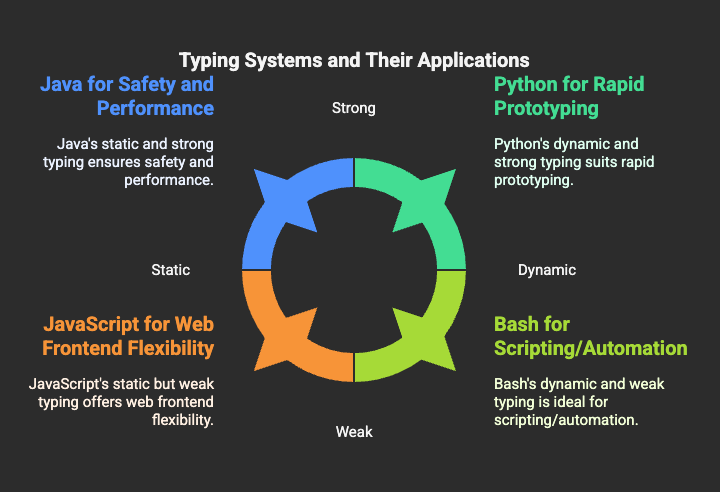
So, a language could bestatically & strongly typed(like Java), ordynamically & weakly typed(like JavaScript).
📌 1. Static vs Dynamic Typing
✅ Static Typing
Type checks happenat compile time(before running the code).
Pros:
- Catches type errors early.
- Better IDE support & refactoring.
- Often faster due to compile-time optimizations.
Cons:
- More boilerplate code.
- Slower prototyping.
💡 Example in Java (Statically Typed)
int age = 25; // Validage = "twenty-five"; // Compile-time error ❌
🛠 Statically Typed Languages
- Java ☕
- C, C++
- Kotlin
- Go
- Rust
- TypeScript (adds static types to JS)
- Scala
✅ Dynamic Typing
Type checks happenat runtime(while the program runs).
Pros:
- Rapid development.
- Less boilerplate, more flexible.
- Cons:
- Type bugs appear at runtime 😬.
- Harder to refactor or maintain large codebases.
💡 Example in Python (Dynamically Typed)
age = 25 # Integerage = "twenty" # Now a string — no error until you misuse it
🛠 Dynamically Typed Languages
- Python 🐍
- JavaScript
- Ruby
- PHP
- Perl
- Lua
🔐 2. Strong vs Weak Typing
✅ Strong Typing
Languages thatdon’t allow automatic or unsafe type conversions.
- Pros:
- More predictable behavior.
- Fewer unexpected bugs.
Cons:
- May require manual conversions.
💡 Python (Strongly Typed)
print("5" + 5) # ❌ TypeError: can’t concat str and int
✅
Weak Typing
Languages thatallow implicit or unsafe type conversions.
Pros:
- More flexible.
- Quick hacks possible.
Cons:
💡 JavaScript (Weakly Typed)
console.log("5" + 5); // '55' – string concatenation!console.log("5" - 2); // 3 – weird, right? 🤯
🔍 Language Matrix
🥊 Real-World Implications
🧪 Static + Strong (Java, Rust)
- Great forlarge, maintainable apps.
- Catches bugs early.
- Slower to prototype.
⚡ Dynamic + Weak (JavaScript)
- Super flexible.
- Easy to build fast.
- Error-prone and harder to maintain.
🧠 Dynamic + Strong (Python, Ruby)
- Good mix for startups, prototyping.
- Still safer than weakly typed langs.
🚀 Which Should You Use?
🧠 Final Thoughts
There’s no one-size-fits-all.
- Strong typing avoids surprises.
- Static typing gives early feedback.
- Dynamic typing boosts flexibility.
- Weak typing… well, it’s fast, but risky.
Know your trade-offs. Choose based on theproject, team size, and long-term maintainability.