⚡ Reduce Database Round Trips for Faster Application Performance
Every time your application communicates with the database — sending a query and waiting for a response — it initiates a round trip . While each individual t...
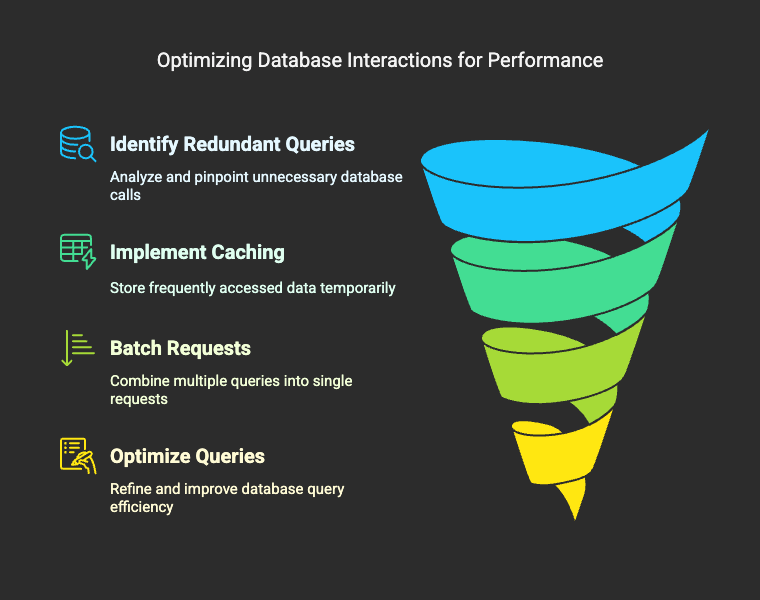
⚡ Reduce Database Round Trips for Faster Application Performance
Why Reducing Round Trips Matters
Every time your application communicates with the database — sending a query and waiting for a response — it initiates around trip. While each individual trip might take milliseconds, these add up quickly when your application sends multiple small queries instead of fewer, optimized ones.
Minimizing database round trips is acritical performance optimizationthat reduces latency, improves throughput, and lightens the load on your database server.
🚨 The Problem with Excessive Round Trips
Imagine this:
# Pseudo-codefor user_id in user_ids: user_data = db.query(f"SELECT * FROM users WHERE id = {user_id}")
If user_ids contains 100 items, this means100 individual queries— 100 round trips — just to fetch user data!
This approach is:
- Latency-heavy: Network overhead for each trip.
- Resource-intensive: Repeated parsing, planning, and execution.
- Scalability killer: Your app won’t scale under load.
✅ Best Practices to Reduce Round Trips
1. Use Batching and IN Clauses
Instead of making separate queries, group them into one.
SELECT * FROM users WHERE id IN (1, 2, 3, 4, 5);
2. Leverage Joins for Related Data
Don’t query parent and child tables separately.
❌ Bad:
SELECT * FROM orders WHERE user_id = 1;-- Then for each order:SELECT * FROM order_items WHERE order_id = X;
✅ Better:
SELECT o.*, oi.*FROM orders oJOIN order_items oi ON o.id = oi.order_idWHERE o.user_id = 1;
3. Use Stored Procedures
Stored procedures allow you to encapsulate logic on the database side, reducing the number of calls from the application.
CALL get_user_order_summary(1);
This single call can fetch complex, multi-table data in one go.
4. Return Only Required Data
Reduce payload size by selecting only the columns you need.
SELECT name, email FROM users WHERE id = 1;
Instead of:
SELECT * FROM users;
5. Minimize Chatty ORM Behavior
Some Object-Relational Mappers (ORMs) make hidden queries.
Enable query logging and use tools like:
- Django: select_related, prefetch_related
- Hibernate: Batch fetching
- Sequelize: include with joins
6. Use Caching Where Appropriate
Caching frequent queries can eliminate round trips altogether. Use:
- In-memory caches (Redis, Memcached)
- Application-level memoization
- HTTP-layer caching for APIs
📊 Real-World Example
Let’s say you want to fetch user profile and their top 3 recent posts:
❌ Multiple Queries:
SELECT * FROM users WHERE id = 7;SELECT * FROM posts WHERE user_id = 7 ORDER BY created_at DESC LIMIT 3;
✅ Optimized:
SELECT u.*, p.*FROM users uLEFT JOIN ( SELECT * FROM posts WHERE user_id = 7 ORDER BY created_at DESC LIMIT 3) p ON u.id = p.user_idWHERE u.id = 7;
🚀 Benefits of Fewer Round Trips
- 🔥 Lower network latency
- 🧠 Better use of DB resources (shared execution plans, reduced locks)
- ⚡ Faster application response time
- 📈 Increased throughput and scalability
Conclusion
Reducing database round trips is one of themost effectiveways to improve bothapplication performanceanddatabase efficiency. With smarter querying patterns, batching, and proper ORM tuning, you can significantly reduce unnecessary trips — resulting in a faster, leaner, and more scalable system.
Start looking into your current queries — chances are, there’s room to cut down the trips. 🛠️