🧠 Mastering Sequential, Concurrent, and Parallel Programming Concepts
Understanding the differences between sequential, concurrent, and parallel programming is essential for building efficient, scalable software. This blog prov...
🧠 Mastering Sequential, Concurrent, and Parallel Programming Concepts
📄 Executive Summary
Understanding the differences between sequential, concurrent, and parallel programming is essential for building efficient, scalable software. This blog provides a deep dive into these programming paradigms, explains when to use each, and gives realistic, language-agnostic pseudocode examples. It also helps you decide which approach fits best for different types of problems.
🔎 Problem Statement
Modern applications need to be responsive, scalable, and performant. Whether you’re processing large data sets, handling multiple client requests, or managing tasks in a UI application, you need to choose the right programming approach.
But how do you decide whether to go sequential, concurrent, or parallel? What are the trade-offs, and how do these models behave internally?
🔧 Solution Deep Dive
✅ Sequential Programming
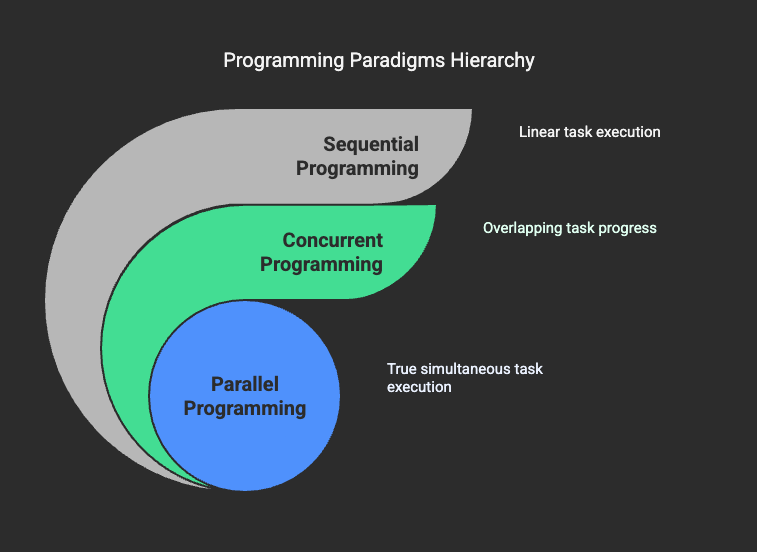
Definition:Tasks are executed one after another. Only one task runs at any given moment.
Real-World Analogy:A single chef preparing one dish at a time.
Pseudocode:
task1()task2()task3()
Pros:
- Simple to understand and debug
- Predictable execution
Cons:
- Inefficient for modern multi-core systems
- Poor performance for I/O-bound or CPU-heavy tasks
Use Cases:
- Scripting, basic automation, CLI tools
🔄 Concurrent Programming
Definition:Multiple tasks progress independently and may interleave execution. Not necessarily in parallel.
Real-World Analogy:A chef preparing multiple dishes by switching between them when waiting (e.g., while something is baking).
Pseudocode:
start task1()start task2()start task3()wait for all to complete
Key Concepts:
- Context switching
- Threads, coroutines, async/await
Pros:
- Efficient I/O handling
- Better resource utilization on single-core CPUs
Cons:
- Synchronization challenges
- Deadlocks, race conditions
Use Cases:
- Web servers (handling many requests)
- GUI applications (responsive UI + background tasks)
⚡ Parallel Programming
Definition:Tasks are executed simultaneously using multiple CPU cores or machines.
Real-World Analogy:Multiple chefs each making a separate dish at the same time.
Pseudocode:
parallel { task1() task2() task3()}
Key Concepts:
- Multi-threading
- Multi-processing
- Distributed systems
Pros:
- Drastic performance improvements on multi-core systems
- Ideal for CPU-bound tasks
Cons:
- Difficult to debug
- Not all problems are parallelizable (Amdahl’s Law)
Use Cases:
- Machine learning pipelines
- Video rendering
- Big data processing
🎯 Realistic Example: Processing 1000 Images
✉ Sequential:
for image in images: apply_filter(image)
Processes images one at a time. Takes the longest.
⌛ Concurrent (using threads):
thread_pool = create_pool(4)for image in images: thread_pool.submit(apply_filter, image)thread_pool.wait()
Better performance by interleaving tasks, not true parallel.
⚖️ Parallel (using multi-processing or GPUs):
split images into 4 chunksprocess each chunk on a separate core simultaneously
Fastest option, each core handles a group of images in parallel.
🔍 Which Language Handles This Well?
Java
- Concurrency Support: Threads, Executors
- Parallelism Support: ForkJoinPool, Streams
- Best For: Enterprise apps, CPU-intensive tasks
Python
- Concurrency Support: asyncio, threading
- Parallelism Support: multiprocessing, Dask
- Best For: Data science, I/O-heavy workloads
Go
- Concurrency Support: Goroutines
- Parallelism Support: Goroutines + Channels
- Best For: Network apps, microservices
JavaScript
- Concurrency Support: Event loop, Promises
- Parallelism Support: Workers (browser, Node.js)
- Best For: Front-end, serverless applications
Rust
- Concurrency Support: async/await, Tokio
- Parallelism Support: Rayon, threads
- Best For: Systems programming
C++
- Concurrency Support: std::thread, coroutines
- Parallelism Support: OpenMP, Intel TBB
- Best For: High-performance computing
📊 Pros & Cons Summary
Sequential Programming
- ✅ Simple, easy to read and reason about
- ❌ Slow execution, doesn’t scale well with modern hardware
Concurrent Programming
- ✅ Efficient resource usage, more responsive applications
- ❌ Requires careful synchronization, potential for race conditions and deadlocks
Parallel Programming
- ✅ Best performance on multi-core processors
- ❌ Complex debugging and management, harder to scale safely without errors
🧪 FAQs
Q: Is concurrency the same as parallelism?
No. Concurrency is aboutmanagingmultiple tasks, parallelism is aboutexecutingthem simultaneously.
Q: Can I use both concurrency and parallelism in the same app?
Absolutely. Many applications mix both to optimize responsiveness and throughput.
Q: What is Amdahl’s Law?
It states the potential speedup of a program using parallelism is limited by the portion that must run sequentially.
Q: Is multithreading always better?
Not always. It adds overhead and complexity. It shines in specific I/O or CPU-heavy contexts.
Q: Which is easier to debug — concurrency or parallelism?
Neither is easy, but concurrency is generally safer. Parallelism issues (e.g., race conditions) are often harder to reproduce.
🚀 Call to Action
If you’re building responsive UIs, high-speed computation systems, or scalable APIs, understanding these models is non-negotiable. Choose the right paradigm based on your workload, use language-native tools, and profile your performance.
Want to explore specific examples in Java, Python, or Go? Leave a comment or request a follow-up blog!
Stay tuned for more deep dives into threading models, async runtimes, and performance tuning.
Happy coding ✨